
Most corporate travel policy addresses the risks an insurer worries about. It says almost nothing about what an employee should actually do when the situation deteriorates and help is some hours away.
Clint Emerson spent twenty years as a Navy SEAL and went on to advise corporations on exactly that gap. This book is the field-manual version — short, illustrated, organised by scenario, and written to be understood by someone who has never had a day of training.
Take the title as marketing. What is underneath is a competent primer on operating in degraded conditions.
What the book actually covers
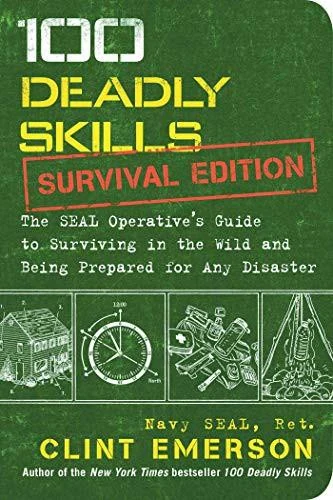
The Survival Edition is the wilderness and disaster volume in Emerson's series, distinct from the earlier book's focus on evasion and personal security. Its subject is what to do when normal systems stop working.
The organisation is by problem. Water — finding it, judging it, making it safe. Shelter and exposure management, which kills faster than most people expect. Fire. Signalling and being found. Navigation without electronics. Basic field medicine for the injuries that actually occur. Vehicle preparation and what a genuinely useful kit contains. Communications when the network is down.
The presentation is deliberately spare: each skill gets a page or two, illustrated, with the reasoning compressed to what you need. That format is the book's virtue — it is designed to be recalled under stress rather than studied at leisure.
The underlying principle is preparation over improvisation. Emerson's consistent point is that competence in these situations is almost entirely a function of decisions made beforehand: what you carry, what you have checked, and what you have already thought through. Nobody reasons well when cold, frightened and tired.
Why it matters for your risk posture
Read it as a duty-of-care baseline. Organisations sending staff into places with unreliable infrastructure — remote sites, developing markets, disaster-affected regions — carry a real obligation, and most briefings cover political risk and disease while ignoring the mundane scenarios that are far more likely to occur.
Read it for the preparation argument. Almost every skill in the book resolves to something decided in advance: a kit assembled, a route understood, a rendezvous agreed, a check-in schedule established. Those are all organisational controls rather than individual heroics, and they are cheap.
And read it with proportion. This is an awareness primer, not training. Reading about field medicine is not competence in field medicine. For an organisation with genuine exposure, the correct response is a proper journey management framework and, where warranted, actual instruction. The book's value is that it tells a non-specialist reader what the questions are.
Key takeaways
- Preparation beats improvisation, comprehensively. Almost every outcome in this book is determined by decisions made before departure.
- The mundane scenarios are the likely ones. Exposure, dehydration, a vehicle failure and no signal will affect far more travelling staff than anything dramatic.
- Design for degraded cognition. People do not reason well when cold, frightened and exhausted. Checklists and pre-agreed protocols exist for that reason.
- Awareness is not capability. A useful primer that tells you what you do not know. Treat it as the beginning of a duty-of-care conversation, not the conclusion.
About the author
Clint Emerson is a retired United States Navy SEAL with two decades of service, including work in special operations and, by his own account, assignments involving national intelligence agencies.
Since leaving the military he has worked in corporate security, founding a practice advising organisations on crisis management, travel risk and personnel safety. The 100 Deadly Skills series grew out of that work — the original volume focused on evasion, surveillance detection and personal security, with this Survival Edition covering wilderness and disaster scenarios.
Beyond the Book
Clint Emerson — retired Navy SEAL; corporate security practitioner
- The companion volume: the original 100 Deadly Skills covers evasion, surveillance detection, and personal security in urban and hostile environments. For a travelling executive that is arguably the more relevant of the two.
- The consulting is the professional version. He founded a practice advising corporations on travel risk and crisis preparedness — the delivered form of everything the books describe.
- Read alongside: Scaling Force by Rory Miller for graduated response and the legal framing around it, and MI6 Spy Skills for Civilians for the surveillance-awareness and safe-travel material. The three cover the same duty-of-care ground from different services.
Get your copy
Get your copy
Order 100 Deadly Skills: Survival Edition on Amazon: find it here.