
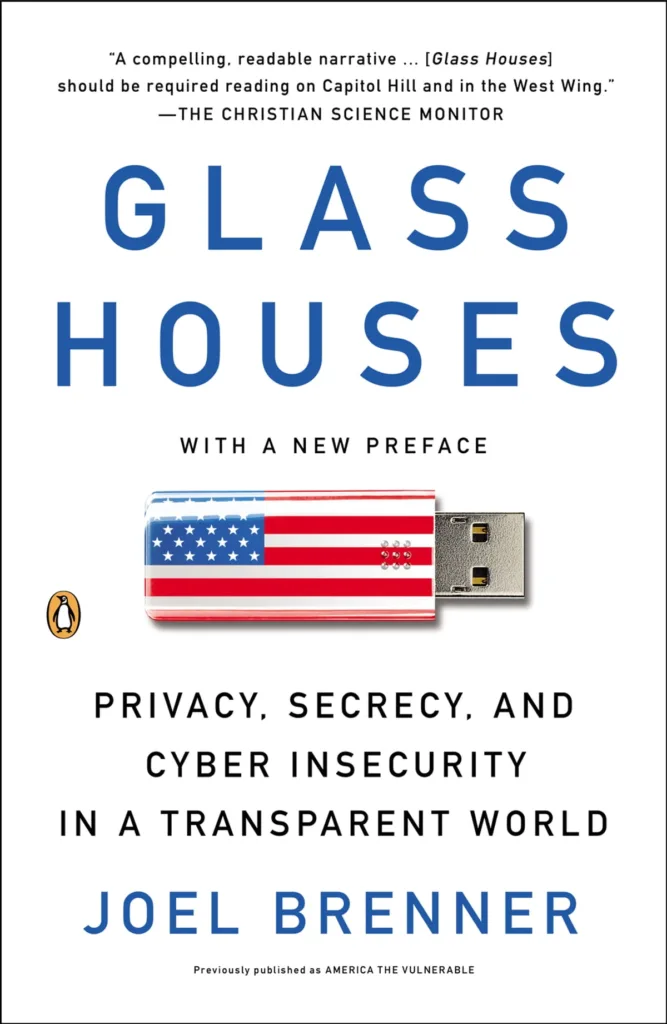
The book was published in 2011 as America the Vulnerable. The 2013 paperback carries a different title, Glass Houses: Privacy, Secrecy, and Cyber Insecurity in a Transparent World, and includes a new preface.
Joel Brenner spent 2002 to 2006 as Inspector General of the National Security Agency and 2006 to 2009 as the National Counterintelligence Executive — the head of US counterintelligence under the Director of National Intelligence. He is therefore writing about surveillance and secrecy from inside both the agency that conducts it and the office responsible for defending against everyone else's.
His argument is that the insecurity is structural. The networks that carry commercial, governmental and personal life were built for reachability, not for confidentiality, and the openness that makes them valuable also makes them harder to defend.
The case studies date from the early 2010s and some of the technology discussion has been overtaken. Brenner’s questions about who bears responsibility for defending open networks still make the book worth reading.
What the book covers
Brenner works through four overlapping problems: state-sponsored economic espionage, principally Chinese; the erosion of privacy by commercial data collection rather than by government; the vulnerability of industrial control systems and critical infrastructure; and the legal and institutional confusion about who is responsible for defending private networks against state-level adversaries.
The strongest chapters are on economic espionage. Brenner had visibility into the scale of intellectual-property theft from US companies and is precise about the mechanics — not dramatic intrusions but sustained, patient, low-signature collection against firms that did not consider themselves targets and had no framework for thinking about a nation-state as an adversary.
Brenner is at least as concerned about what private companies assemble as about what governments collect, and he is clear that the two are connected: commercial aggregation creates a resource that states may seek to use.
Brenner gives more space to how organizations are exposed than to how they might govern that exposure. The policy discussion draws on US institutions, so readers elsewhere will want to consider how the proposals fit their own legal and institutional setting.
Implications for risk management
Most security spending is organized around controls — what we bought, what we configured, what we audit. Brenner's argument is that the exposure is a property of the architecture, and that a well-controlled organization on a fundamentally open network is still exposed. The distinction matters for budgeting because effective controls can still leave material risks.
In Brenner’s examples, some of the heaviest losses came at mid-sized firms that had not anticipated a state-level threat. A process, a formula or a customer list can be valuable enough for a government to commit resources to obtaining it.
Brenner brings a counterintelligence perspective to commercial security. Brenner's instinct is to ask who the adversary is and what they are trying to learn, before asking what the vulnerability is. Starting with those questions can help an organization decide which vulnerabilities to examine first.
Brenner asks first who would want what an organization holds, and only then where it is vulnerable. We follow the same order in scoping threat intelligence and security assessments for clients whose formula, process or customer list would interest a state-level adversary. Establishing what such an adversary would be prepared to spend determines which controls deserve testing first. It also keeps the work on the exposure Brenner describes rather than on a generic checklist.
Key takeaways
- The exposure is architectural. Controls can reduce the risks of open networks even when the underlying exposure remains.
- Organizations can underestimate their appeal to state-level adversaries. Brenner describes firms with valuable intellectual property that had not anticipated such a threat.
- Commercial aggregation and state collection converge. Data assembled for advertising can also serve as an intelligence resource.
- Adversary before vulnerability. Knowing what an adversary wants and what they might spend can help prioritize controls.
- Two titles, one book. Glass Houses is the retitled paperback edition of America the Vulnerable.
About the author

Joel Brenner was Inspector General of the National Security Agency from 2002 to 2006, responsible for the agency's internal audits and investigations, and served from 2006 to mid-2009 as the National Counterintelligence Executive, heading US counterintelligence under the Director of National Intelligence. He later returned to the NSA as Senior Counsel.
He is a lawyer by training, has practiced in private firms, and is now affiliated with MIT, where he has worked on internet policy and security. The combination — audit, counterintelligence, and law — explains the book's cast of mind: it is more interested in institutional responsibility than in technology.

Get the book
Glass Houses: Privacy, Secrecy, and Cyber Insecurity in a Transparent World
Find it on Amazon
Where the proceeds go
We donate 100% of what we earn to Children of Fallen Heroes
If you buy through the link above we may earn a small commission, at no extra cost to you. Every penny of it goes to Children of Fallen Heroes, a registered 501(c)(3). We keep none of it.
They are developing an 82-acre campus in Vass, North Carolina for the children of military families, first responders and foster youth — STEAM education in aviation, robotics and drones, alongside leadership and healing programs. Over eleven years their programs have reached more than 15,000 young people and families.
We participate in the Amazon Services LLC Associates Program and similar affiliate programs; these relationships do not influence our recommendations. Cookies and similar technologies record interactions with affiliate links — see our Privacy Policy to disable them, or reach us via Contact.