
Most memoirs by former intelligence officers are written to settle a reputation. Ric Prado's is unusual because the interesting material is procedural. Strip out the biography and what remains is a long, specific account of how clandestine work is actually organised: how people are assessed before they are trusted, how operations are planned around the assumption that something will fail, and how risk is carried by individuals rather than by systems.
Prado spent roughly twenty-four years at the CIA, most of it in its paramilitary arm, and ended as chief of operations in the Counterterrorist Center's Bin Laden unit. Black Ops is his account of that career. For a reader who assesses exposure for a living, the value is not the adventure. It is watching an organisation that treats verification, compartmentation and contingency as routine rather than as compliance overhead.
What the book actually covers
The arc runs from Prado's childhood in Cuba and his family's exile, through service as a US Air Force pararescueman, into the CIA's Special Activities Division and a series of postings — Central America during the Contra years, the Philippines, Korea — before the counterterrorism work that occupied the end of his career.
The operational content is the substance. Prado is detailed on how relationships with sources are built and, more importantly, how they are tested: the slow accumulation of small verifications, the deliberate inconsistencies introduced to see what comes back, the working assumption that a person's stated motive is rarely their whole motive. He is equally clear that this is not cynicism but process — you cannot run an operation on someone you have not independently corroborated, however plausible they are in the room.
He is candid about failure. Plans degrade, communications break, people do not behave as predicted, and the difference between a bad outcome and a catastrophe is usually whether a fallback existed and whether anyone had rehearsed it. The later chapters, covering the Counterterrorist Center, describe an organisation attempting to reorganise itself around a threat it had already been warned about — a familiar shape to anyone who has watched a risk register fail to translate into action.
Why it matters for your risk posture
Read it for the vetting discipline. Prado's world runs on the premise that trust is granted incrementally and withdrawn cheaply, and that the moment you stop corroborating is the moment you are exposed. That is the same premise underneath executive background work and counterparty diligence, described here by someone for whom the consequence of getting it wrong was not financial.
Read it for the treatment of contingency. The book is a sustained argument that planning for the expected case is not planning. Operations are built around what happens when the primary route closes — a habit most commercial organisations only acquire after an incident.
And read it for the human factors. Prado is good on what sustained operational pressure does to judgement, on the cost of compartmentation to the people inside it, and on the organisational tendency to reward the visible over the careful. Those dynamics are not confined to intelligence services.
Key takeaways
- Trust is a process, not a judgement. Corroborate independently and repeatedly; the plausible source is the one worth checking hardest.
- A plan without a rehearsed fallback is a hope. The distinguishing feature of professional operations is what happens when the first option fails.
- Compartmentation has a cost, and it is paid by people. Restricting information protects the operation and isolates the operator; both effects are real.
- Warnings are not the scarce resource. The Counterterrorist Center chapters describe an institution that knew, and the gap between knowing and acting.
About the author
Enrique “Ric” Prado was born in Cuba and came to the United States as a child. He served in the US Air Force as a pararescueman before joining the Central Intelligence Agency, where he spent around twenty-four years, much of it in the Special Activities Division, the Agency's paramilitary component.
His postings included Central America during the 1980s, the Philippines and Korea. He later served as chief of operations for the Bin Laden Issue Station within the CIA's Counterterrorist Center. After leaving government service he worked in the private security sector.
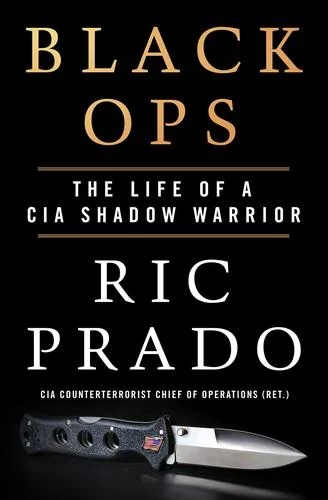
Black Ops: The Life of a CIA Shadow Warrior was published by St. Martin's Press in 2022.
Beyond the Book
Ric Prado — CIA Counterterrorist Center, chief of operations (ret.)
- The book is the record. Prado's account was cleared through the CIA's Publications Review Board, which is itself informative: the redaction shapes what a career of this kind can be said about publicly.
- Read it for method, not for verdicts. The operational passages — source assessment, contingency, compartmentation — transfer. The policy arguments are one participant's view of contested events, and should be read as such.
- Read alongside: The Gift of Fear by Gavin de Becker for the individual-level version of reading intent, and People Hacker by Jenny Radcliffe for the civilian mirror image of building false trust rather than detecting it.
Get your copy
Get your copy
Order Black Ops: The Life of a CIA Shadow Warrior on Amazon: find it here.