
Most of the wars in this book open the same way: with someone confidently misdescribing the war they are about to fight. The French in Algeria took themselves to be suppressing a criminal insurrection, won most of the engagements and lost the country. The British in Malaya concluded early that they were in a political contest that happened to involve soldiers, and organiized accordingly. Same era, comparable problems, opposite results.
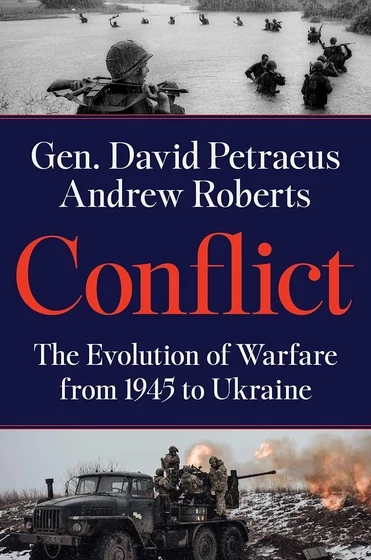
That contrast sits near the center of Conflict: The Evolution of Warfare from 1945 to Ukraine, by General David Petraeus and the historian Andrew Roberts. It is a long book with a short thesis: what decides a conflict is rarely the technology and almost never the opening plan, but whether those in charge understood the contest they entered and could notice when they were wrong.
Substitute “market entry” or “crisis response” for “campaign” and the failure mode is familiar — a strategy fixed at the moment of least information, then defended long after the facts have moved.
What the book actually covers
The survey is chronological and unusually wide: the wars of decolonisation in Indochina, Malaya, Algeria and Kashmir; Korea; the Arab–Israeli wars; Vietnam; the Soviet occupation of Afghanistan; the Falklands; the Iran–Iraq war; the Gulf War; the Balkans; Somalia and Rwanda; then Iraq, Afghanistan and Ukraine. Roberts supplies the historian's range, Petraeus the commander's account of campaigns he ran.
Holding it together is Petraeus's framework of the four tasks of strategic leadership. Get the big ideas right. Communicate them through the breadth and depth of the organiization. Oversee implementation. Then work out how they must be refined, and repeat. Leaders who manage all four, the authors note, are rare; the fourth is the one routinely skipped.
Campaign after campaign is then examined for which task was fumbled, and when. The longest treatment goes to Iraq and Afghanistan, where Petraeus writes from command experience, including the counterinsurgency doctrine he oversaw and the 2007–08 surge. That is also the book's plainest limitation: he is assessing decisions he was party to.
Ukraine is the framework's clearest test case. Russian assumptions about Ukrainian cohesion, about their own logistics and about the Western response were wrong in nearly every particular, and the machinery for correcting them was slow. Alongside runs the book's second theme: the battlefield has become very hard to hide anything on. A closing chapter extends that to unmanned systems, artificial intelligence and cyber, without declaring mass obsolete.
Why it matters for your risk posture
Read it for the diagnostic value of the four tasks, which transfer intact to any organiization with a plan and a hierarchy. Most institutions manage the first three tolerably. Very few build a real mechanism for the fourth: a standing process that asks whether the original premise still holds, owned by someone empowered to say it does not.
Read it because the book is a long study of how a bad initial assessment survives contact with contradictory evidence. The mechanism is institutional rather than personal — reporting lines that reward confirmation, metrics chosen to flatter the plan, a shrinking group willing to send bad news upwards. The executives we work with will recogniize the pattern from due diligence files.
Read it for the material on transparency, which has the most direct commercial application. If armies can no longer conceal formations from commercially available imagery, assumptions about the confidentiality of your sites, shipments, movements and personnel deserve a fresh look.
Key takeaways
- The opening assessment does the most damage. Errors made when information is thinnest get locked into budgets and public commitments, and grow harder to reverse as investment accumulates.
- Adaptation is a process, not a temperament. Willingness to change one's mind is useless without a routine that forces the question on a schedule.
- Communication is a command task, not a comms task. The authors treat transmitting a strategy through an organiization as core leadership work, not something delegated after the decision.
- Assume you can be observed. The tools that stripped concealment from the battlefield are cheap, commercial and widely held.
About the author
David Petraeus served thirty-seven years in the United States Army. He commanded the 101st Airborne Division during the 2003 invasion of Iraq, oversaw production of the US Army and Marine Corps counterinsurgency field manual, led coalition forces in Iraq during the 2007–08 surge, then US Central Command, then international forces in Afghanistan, before serving as Director of the CIA. His Princeton doctorate examined the American military and Vietnam.
Andrew Roberts is a British historian whose books include Napoleon the Great, Churchill: Walking with Destiny and The Storm of War. A Fellow of the Royal Society of Literature and of the Royal Historical Society, he has held a visiting professorship in War Studies at King's College London and was created Baron Roberts of Belgravia in 2022.
Conflict: The Evolution of Warfare from 1945 to Ukraine by General David Petraeus and Andrew Roberts, HarperCollins, 2023.
Beyond the Book
David Petraeus and Andrew Roberts — a field commander and a narrative historian, each pulling the other out of his habits.
- Read the practitioner chapters with the practitioner in mind. The Iraq and Afghanistan sections are the most detailed and the most invested. That does not make them wrong; it makes them evidence with a provenance.
- Breadth costs depth. Seventy years across several continents means some campaigns get a handful of pages. Treat those as orientation rather than authority.
- The framework travels better than the history. If one thing goes into a board pack, make it the four tasks and the discipline of the fourth.
- Read alongside: Lawrence Freedman's Strategy: A History for the theory the narrative rests on, and Andrew Roberts's The Storm of War for his method applied to a single conflict.
Get your copy
Get your copy
Order Conflict: The Evolution of Warfare from 1945 to Ukraine on Amazon: find it here.