
In June 2010 a small antivirus firm in Belarus was asked to look at machines in Iran that kept crashing and rebooting. The code they eventually isolated was signed with legitimate digital certificates, carried several unpatched Windows exploits, and spread by USB stick. It was not built to steal data; it was built to damage equipment. It took months of work by researchers in Europe and North America to establish that.
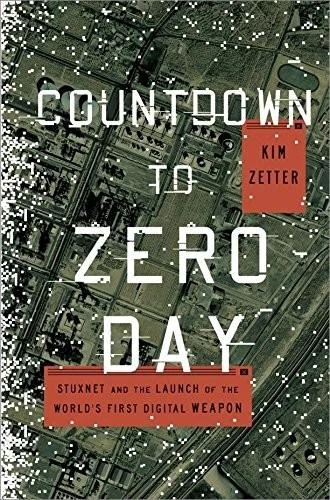
Countdown to Zero Day is Kim Zetter's account of Stuxnet: how it was built, how it was found, what it did to Iran's uranium enrichment program at Natanz, and what its discovery meant for everyone else. It is a technical book written for non-specialists, and it remains the clearest published narrative of a digital attack that caused physical destruction.
For a risk audience this is the most operationally relevant title on the list. Strip out the geopolitics and what remains is a case study in crossing an air gap, abusing a supply chain, hiding behind trusted credentials, and deceiving the people watching the control screens. Every one of those techniques is now ordinary.
What the book actually covers
The book opens as a detective story. VirusBlokAda, the Belarusian firm that first isolated the files, passed the problem outward. Researchers at Symantec reverse-engineered the code over months; in Germany, the industrial control consultant Ralph Langner and his colleagues worked out what the payload was aimed at. None of them had access to the target, a brief from a client, or official cooperation. They deduced intent from the binary.
What they found was unusually expensive. Stuxnet used four previously unknown Windows vulnerabilities — an extravagance, since each is valuable and using one burns it permanently. Its drivers were signed with certificates stolen from two Taiwanese hardware manufacturers, so the operating system trusted them. It propagated through removable media because the target was not connected to the internet. And its payload ignored ordinary machines entirely, activating only on a particular Siemens industrial controller configuration.
The sabotage itself is the part worth reading twice. The code altered the speed of the frequency converters driving Iran's IR-1 centrifuges, running them well above and then far below their normal operating range, in short episodes separated by weeks of apparently normal behavior. Meanwhile it recorded legitimate process readings and replayed them to the monitoring systems, so operators saw a healthy plant. Inspection cameras at Natanz recorded the removal of roughly a thousand centrifuges.
Zetter then widens out. She covers the operation's reported origins as a joint American-Israeli program sustained across two administrations, the related malware families found in its wake, the trade in zero-day exploits that supplies attackers and defenders alike, and the awkward fact that Stuxnet was discovered at all only because it spread beyond its target. Attribution, in her telling, was slow and partial, assembled from code artefacts, timing and eventual leaks.
Why it matters for your risk posture
Read it because your operational technology sits outside most of what your security program actually covers. Building management, access control, cold chain, manufacturing lines, logistics: long-lived equipment, thin patching windows, vendors with standing remote access, and an asset register that is usually incomplete. The exposure here is stoppage and physical damage, not data loss.
Read it for the supply-chain lesson, which is the most transferable part of the book. The attackers did not go at Natanz directly. They went at what Natanz trusted — contractors, engineering equipment, removable media, and the code-signing certificates of firms with no connection to the target. Trust markers are assets. They can be stolen, and the theft is rarely noticed by whoever owns them.
Read it because attribution is a slow process and your obligations are not. Reporting windows are measured in hours, insurers ask whether an act-of-war exclusion applies, and counterparties want a name. Stuxnet took months to characteriize and years to attribute publicly. Plan disclosure and communications on the assumption that you will not know who did it.
Key takeaways
- An air gap is a control, not a boundary. Stuxnet was designed on the assumption that people carry data across the gap, because they always do. Removable media and engineering laptops deserve the scrutiny you give email.
- A valid signature is not evidence of a safe file. Certificates stolen from unrelated manufacturers made hostile drivers look legitimate to the operating system. Treat code signing as one signal among several.
- Instrumentation can be made to lie. The attack replayed recorded readings so the control room saw normal operations. Verify critical process data by a route the attacker does not control.
- Assume you cannot attribute quickly. Response plans that depend on knowing the adversary — for insurance, disclosure or escalation — will stall exactly when they are needed.
About the author
Kim Zetter is an American investigative journalist who has covered cybersecurity and national security since 1999. She began reporting in Israel, writing for the Jerusalem Post, before spending thirteen years at Wired, where she became one of the few reporters able to handle this material without either overstating or flattening the technical detail.
She has written for the New York Times Magazine, the Washington Post, Politico, The Guardian and The Intercept, and launched an independent newsletter, Zero Day.
Countdown to Zero Day: Stuxnet and the Launch of the World's First Digital Weapon, Crown Publishers, 2014.
Beyond the Book
Kim Zetter - investigative journalist specialiizing in cybersecurity, surveillance and election security.
- On the reporting: the book rests on interviews with the researchers who did the reverse-engineering, read against the published technical analyzes. Where the evidence stops, she says so.
- If you read only two chapters: take the ones on the payload and the centrifuges. They are the clearest non-specialist explanation of an industrial control attack in print.
- Read alongside: Andy Greenberg's Sandworm (2019), which follows the same logic into attacks on Ukraine's power grid and the NotPetya outbreak, and Matthew Aid's The Secret Sentry for the collection side of the same agencies.
Get your copy
Get your copy
Order Countdown to Zero Day: Stuxnet and the Launch of the World's First Digital Weapon on Amazon: find it here.