
In 2007 the Secretary of Defense of the world's best-funded military learned from a newspaper investigation that wounded soldiers were living in squalor and administrative limbo at the army's flagship hospital. His own reporting chain had told him nothing. Within weeks the Secretary of the Army was gone.
Duty is Robert Gates's account of four and a half years running the American defense establishment through two wars and two presidents of opposing parties: appointed by George W. Bush to salvage Iraq, kept on by Barack Obama. It is candid, and not really a war book.
It is a book about an institution that resisted doing the thing it existed to do. For anyone accountable for a large organiization under pressure, that is the useful subject: how a well-resourced machine built for one state of the world fails to convert to another, and what it costs to force it.
What the book actually covers
Gates arrived in December 2006 with Iraq deteriorating and left in mid-2011. The narrative runs through the Iraq surge, the 2009 Afghanistan strategy reviews and the troop increase that followed, the repeal of the ban on openly gay service members, and the bin Laden raid. But the spine is his fight with his own department.
The pattern recurs: a wartime requirement meets a peacetime process. He pushed mine-resistant vehicle funding through against service objections; the services preferred to protect long-term programs. He pressed the Air Force repeatedly to release surveillance aircraft to field commanders, and set hard targets for battlefield medical evacuation. Each time he built task forces reporting directly to him, because the ordinary chain would not move at the war's speed.
He is equally direct about accountability. Walter Reed cost the Secretary of the Army his job; failures in the custody of nuclear components cost the Air Force both its civilian secretary and its chief of staff. He relieved one Afghanistan commander, and a year later lost a second to a resignation the President accepted. In 2009 he capped or canceled a long list of major programs, describing the coalition of services, contractors and legislators that formed against him.
The political chapters made the headlines: a National Security Council staff reaching past him to field commanders, a president he believed backed the Afghanistan strategy without believing in it, a bleak view of Congress. These are his characteriizations, contested at the time. The book's real weight lies elsewhere. He wrote to the families of the dead, visited the wounded, and describes going home and weeping — not sentiment, he argues, but calibration: he wanted every decision to cost him something.
Why it matters for your risk posture
Read it for the clearest available portrait of an institution resisting its own purpose. Nothing there was under-resourced. Its processes, incentives and career paths were built for a state the organiization was no longer in. Anyone running procurement or operations will recogniize the shape.
Read it because the reporting line told him nothing. Walter Reed had been failing for years, and the news reached the Secretary through a newspaper. Assurance traveling up the same chain as accountability is not assurance; it is a summary written by the people being assessed.
Read it for the cost side of the ledger, which risk registers rarely carry. Decisions land on people, and sustained crisis has a personal half-life for whoever takes them. Gates's departure is a reminder that senior capacity is finite and depleting, and that almost nobody monitors it.
Key takeaways
- Peacetime process does not become wartime process on its own. Someone senior has to force it, repeatedly, against people behaving rationally within their own incentives.
- Assurance flowing up the accountability chain is not assurance. If the report is written by those being assessed, you need a second, independent route for bad news.
- Removing people is a control, and a signal. He used dismissal sparingly and publicly; the effect was less about individuals than about what the organiization understood to be survivable.
- Senior judgment is a depleting resource. Sustained crisis wears down decision-makers; treat their capacity as something to measure, not assume.
About the author
Robert Michael Gates was born in Wichita, Kansas in 1943. He joined the CIA in 1966, took a doctorate in Russian and Soviet history at Georgetown, served as deputy national security adviser under George H. W. Bush, and in 1991 became Director of Central Intelligence — the only career officer to reach the post from entry level.
He left government in 1993, published From the Shadows (1996), then led Texas A&M University. He was serving on the Iraq Study Group when nominated as Secretary of Defense in 2006, and became the first holder of the office asked to stay on by a newly elected president of the other party. He received the Presidential Medal of Freedom on leaving in 2011, and became chancellor of William & Mary in 2012.
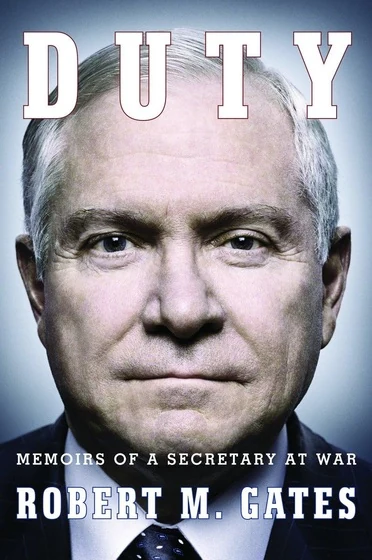
Duty: Memoirs of a Secretary at War by Robert M. Gates, published by Alfred A. Knopf, 2014.
Beyond the Book
Robert M. Gates - career intelligence officer, university president, Secretary of Defense to two presidents
- Read the management chapters first. Small teams reporting directly to him, close attention to a few metrics, visible consequences: that is the transferable part.
- Discount the score-settling. The White House passages drew the coverage and are the least reliable, being the most self-interested.
- Note what he does not fix. He wins particular battles — vehicles, surveillance, evacuation times — by personal intervention, which diagnoses the system rather than repairing it.
- Read alongside: A Passion for Leadership by Robert M. Gates (2016) and Bureaucracy by James Q. Wilson (1989).
Get your copy
Get your copy
Order Duty: Memoirs of a Secretary at War on Amazon: find it here.