
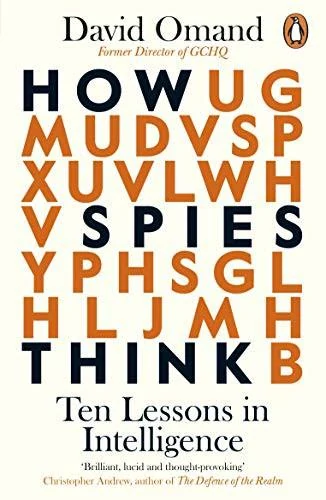
David Omand ran GCHQ, served as the UK's first Security and Intelligence Coordinator, and spent a career watching intelligence assessments succeed and fail at the highest possible stakes.
His argument in this book is that the discipline intelligence analysts use to reach conclusions under uncertainty is not specialist knowledge. It is a transferable method — and most of the errors organisations make in assessing risk are errors that method is specifically designed to prevent.
What the book actually covers
Omand's organising structure is a four-part model of analysis, taught as a sequence.
Situational awareness. What is happening, established as fact and distinguished carefully from what is assumed. Most failures begin here, with inference silently promoted to observation.
Explanation. Why it is happening. This is where the analyst must generate and test competing hypotheses rather than settling on the first coherent story, and where Omand introduces Bayesian reasoning — the discipline of holding a prior estimate and updating it proportionately as evidence arrives, rather than lurching between certainties.
Estimation. What is likely to happen next, expressed with explicit confidence levels rather than false precision or useless vagueness.
Strategic notice. What developments should be anticipated even though they are not currently indicated — the deliberate practice of thinking about what would surprise you, before it does.
Around this he builds a set of warnings drawn from real intelligence failures: the seduction of the confirming detail, the danger of the compelling narrative, the way conspiratorial thinking mimics analysis, and the specific ways deliberate deception is constructed to exploit an analyst's expectations.
The lessons are illustrated with cases from his own career and from the documented record, including the assessments that went badly wrong.
Why it matters for your risk posture
Read it because the four-part model maps directly onto due diligence work. A background investigation produces situational awareness; the client needs explanation, estimation and strategic notice. Knowing the difference between those layers is what separates a report that lists findings from one that supports a decision.
Read it for the Bayesian discipline. The practical instruction — start with an explicit prior, update proportionately, resist the single dramatic data point — is the correct method for assessing a counterparty, a candidate or a market entry, and it is rarely applied deliberately outside intelligence and finance.
And read it for the deception chapters. Omand's account of how deliberate deception is engineered against an analyst's expectations is directly applicable to fraud, to sanctions evasion and to any situation where a subject is constructing a picture for you to find. The defence begins with knowing that the picture may have been assembled for your benefit.
Key takeaways
- Separate the four questions. What is happening, why, what follows, and what should be anticipated. Conflating them is the root of most assessment failure.
- Hold a prior and update it proportionately. The single dramatic finding should move your estimate, not replace it.
- Test competing hypotheses, not the first coherent one. A story that explains the evidence is not the same as the story most likely to be true.
- Deception is built against your expectations. Assume a hostile subject knows roughly what you will look for, and assess accordingly.
About the author
Sir David Omand served as Director of GCHQ and subsequently as the United Kingdom's first Security and Intelligence Coordinator in the Cabinet Office, with responsibility for the professional health of the intelligence community and for national counter-terrorism strategy. He was previously Permanent Secretary at the Home Office and held senior positions at the Ministry of Defence.
Since leaving government he has taught in the War Studies department at King's College London, and has written on intelligence, security policy and the ethics of secret intelligence.
How Spies Think: Ten Lessons in Intelligence was published in 2020. Falcone International previously featured it as Book of the Month in June 2023; this review revisits it in the current format.
Beyond the Book
Sir David Omand — former Director, GCHQ
- He has taught, and publicly. Omand has held a teaching position in War Studies at King's College London, and has lectured on intelligence and security policy.
- His other books: Securing the State, on national security policy and intelligence machinery, and Principled Spying, on the ethics of intelligence work, written with Mark Phythian.
- He has commented widely in UK broadcast and print media on intelligence and security matters, which is the freely available version of his analysis.
- Read alongside: Spy the Lie, on reading individual deception, and The Gift of Fear by Gavin de Becker on pre-incident indicators. Omand supplies the analytical framework those two operate inside.
Get your copy
Get your copy
Order How Spies Think on Amazon: find it here.