
A Secret Service agent took Dick Cheney by the belt and shoulder and propelled him out of his office, down a stairway and into the tunnel that runs to the shelter beneath the East Wing. Within the hour he had authoriized American fighter aircraft to shoot down civilian airliners. He says here that he gave the order after speaking to the President; the 9/11 Commission could not corroborate the call.
That unresolved disagreement is the book in miniature: a consequential decision taken fast on partial information, recounted by a man who concedes little. In My Time spans four decades in the executive branch — White House chief of staff at thirty-four, six terms in Congress, Secretary of Defense through Desert Storm, then eight years as an unusually powerful vice president.
It is not a reflective memoir but a brief for the defense, which is why it repays the time. Risk and legal readers rarely watch a senior decision-maker rebuild his reasoning after the outcome is known: which facts he keeps, which he demotes, where the justification quietly shifts.
What the book actually covers
The first third is career: a Wyoming upbringing, two failures at Yale and drink-driving arrests he does not hide, then a congressional fellowship that put him in Donald Rumsfeld's orbit and, six years later, in the Ford White House. Six terms in Congress follow, then four years at the Pentagon covering Panama, the Gulf War and the post-Cold War drawdown.
Its center is the eight years after 2000, and its organiizing argument is presidential power. Cheney holds that the office had been wrongly weakened after Watergate, and that the right response to September 2001 was to reclaim authority the presidency always possessed. Warrantless surveillance, the detention and interrogation regime, the secrecy around his energy task force — he defends each not as an emergency exception but as proper executive authority.
On Iraq he concedes the intelligence on weapons of mass destruction was wrong and denies the decision was, distinguishing carefully between an assessment being mistaken and a process being dishonest. Whether that distinction holds is the question the book will not settle for you.
He is franker about the second term, when he lost arguments: his isolation over North Korea, his unsuccessful case for a strike on the Syrian reactor, his souring view of Colin Powell and Condoleezza Rice, the rupture with Bush over the refusal to pardon Lewis Libby. Beneath it runs a quieter thread: coronary disease from 1978, and the mechanical pump implanted in 2010 that kept him alive as he wrote.
Why it matters for your risk posture
Read it for the anatomy of a decision taken on an assessment rather than a fact. The Iraq chapters show judgments hardening into premises as they travel upward, the absence of contrary evidence read as confirmation. Anyone who clears a counterparty on a report they did not commission will know the feeling.
Read it because the arrangements a crisis produces outlive the crisis. Powers taken in the autumn of 2001 became standing architecture, later defended on grounds unconnected to the emergency that justified them. The analogue is familiar: the temporary control, the emergency delegation, the workaround built for one transaction and still running.
Read it for practice at handling a contested primary source. This is a witness statement from an interested party, written to persuade, where the omissions carry as much as the assertions. Testing it against the 9/11 Commission report and against those who disagreed is the discipline you apply to any subject's account.
Key takeaways
- An assessment is not a fact, and confidence is not evidence. Probabilistic judgments shed their qualifiers as they climb a hierarchy, and nobody downstream asks to see the original.
- Emergency architecture becomes permanent architecture. Authorities created under time pressure are rarely surrendered; assume anything stood up as temporary will be defended as normal.
- Bypassing process is itself a risk decision. Small, trusted channels buy speed and cost challenge — both effects predictable, neither usually weighed.
- A memoir is a witness statement, not a verdict. Its value lies in what it reveals about the author's reasoning, not in whether it is true.
About the author
Richard B. Cheney was born in Lincoln, Nebraska in 1941 and raised in Casper, Wyoming. He took his degrees at the University of Wyoming, reached Washington on a congressional fellowship in 1968, and worked for Donald Rumsfeld before succeeding him as President Ford's chief of staff at thirty-four.
He served six terms in the House, rising to minority whip, then was Secretary of Defense from 1989 to 1993, receiving the Presidential Medal of Freedom in 1991. After five years running Halliburton he returned as Vice President from 2001 to 2009. He died in November 2025, aged eighty-four.
His co-author is his elder daughter Liz Cheney, a lawyer and former State Department official who later held his old Wyoming seat.
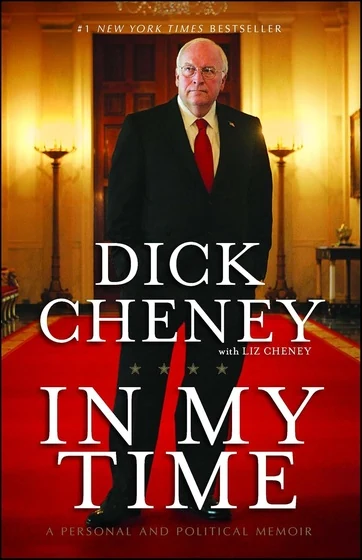
In My Time: A Personal and Political Memoir by Dick Cheney with Liz Cheney, published by Threshold Editions (Simon & Schuster), 2011.
Beyond the Book
Dick Cheney - Vice President, Secretary of Defense, White House chief of staff
- Read it as evidence, not history. Its authority is that he was in the room; its limitation is that he is also the advocate, and often the only witness.
- Watch the losing arguments. The second-term chapters, where he is outvoted, say more about how decisions were made than those where he wins.
- Note what is absent. Hurricane Katrina and the costs of the occupation get far less space than the case for executive power.
- Read alongside: Angler: The Cheney Vice Presidency by Barton Gellman (2008) and The Terror Presidency by Jack Goldsmith (2007).
Get your copy
Get your copy
Order In My Time: A Personal and Political Memoir on Amazon: find it here.