
Most national crime statistics contain no line labeled white-collar crime. There are counts for burglary and for vehicle theft. Fraud and embezzlement appear as offense categories in some systems, counted only where somebody recognized them as crimes. The conduct that concerns a risk function most — the contract steered to a related party, the invoice quietly inflated, the accounting judgment stretched past good faith — sits scattered across regulatory registers, internal files, and nothing at all.
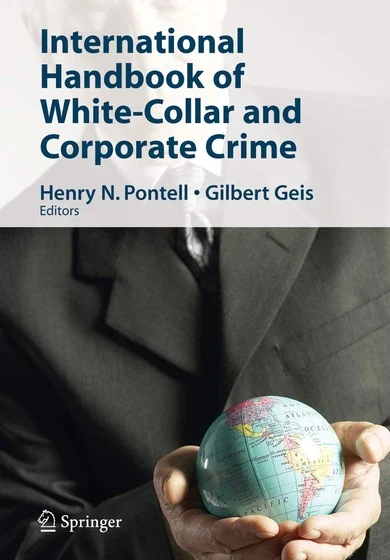
That gap between what happens and what is recorded is a theme running through this handbook, edited by Henry N. Pontell and Gilbert Geis. It collects chapters from criminologists and legal scholars across many jurisdictions, each surveying what is known about offending in a particular country, sector or tradition.
It is a reference work rather than a cover-to-cover read, organized for consultation. Read the definitional and measurement material closely and treat the rest as a map. What it offers a risk audience is not tactics but a disciplined account of why the fraud numbers everyone quotes are weaker than they sound.
What the book actually covers
The first problem is definitional. Edwin Sutherland, who introduced the term in the late 1930s, defined white-collar crime by the offender: a person of standing offending in the course of an occupation. A later tradition defined it by the act — deception, concealment, breach of trust, without physical force. The two produce different populations and different conclusions about who offends; much of the field's disagreement dissolves once you ask which definition a study used.
The second problem is detection. This offending is under-recorded at every stage. Victims often do not know they have been victimized: the harm is diffuse, deferred or disguised as ordinary commercial loss. Institutions that know often prefer private resolution — restitution, a negotiated exit, a quiet write-off — rational for the single organization, corrosive for the record. By the time an act becomes a statistic it has passed through several filters, none of them random.
Third, the handbook is comparative, examining regulation and enforcement in legal traditions where the boundary between corruption, corporate misconduct and ordinary commercial practice sits somewhere else entirely. The coverage is uneven, as in any edited collection, but it shows how much of what an organization treats as a fixed definition of misconduct is local.
Fourth, it addresses sanctioning and the finding that these offenses are punished lightly relative to their aggregate harm: the difficulty of attributing intent inside an organization, the drift toward negotiated settlements, the thin evidence behind deterrence claims. The method throughout is the literature survey — each chapter a specialist summarizing the state of knowledge, with citations dense enough to serve as a research trail.
Why it matters for your risk posture
Read it because your exposure model inherits the blind spots of the evidence beneath it. Loss estimates and industry surveys are built on detected cases, the residue of the filtering this book describes. A program calibrated to that residue is calibrated to what was found, not to what occurred.
Read it for the definitional discipline. Boards routinely conflate categories the literature keeps separate: offending against the organization, offending by the organization against outsiders, and offending by licensed professionals. Each has different populations, warning signs and controls; conflating them produces programs that watch the wrong people.
Read it because under-punishment is a planning assumption, not a grievance. If the realistic consequence of a misconduct type is a negotiated settlement years later, deterrence-based design rests on a weak reed and detection has to carry more weight — a conclusion we would rather clients reach from the research than from experience.
Key takeaways
- The definition determines the finding. Offender-based and offense-based definitions yield different populations; assessments that mix them silently produce incoherent results.
- Detected fraud is a filtered sample. Non-recognition by victims, private resolution by institutions and enforcement discretion each remove cases before anyone counts them.
- Jurisdiction shapes the category. What is prosecuted, regulated or tolerated varies enough that a group-wide misconduct policy needs local translation, not just distribution.
- Deterrence is doing less work than assumed. The evidence for sanction-based deterrence here is thin, which puts the weight back on detection, structure and incentives.
About the authors
Henry N. Pontell and Gilbert Geis edited this handbook from the University of California, Irvine, where both spent much of their careers on economic and organizational crime. Pontell spent much of his career on the UCI faculty and later held a professorship at John Jay College of Criminal Justice, City University of New York. Geis, who died in 2012, was among the founding figures of the modern field: his study of the heavy electrical equipment antitrust prosecutions of 1961 remains a standard reference, and he served as president of the American Society of Criminology.
Pontell's work centered on financial and regulatory fraud, most visibly in research with Kitty Calavita and Robert Tillman on the savings and loan collapse, which examined how deregulation, insider control and weak supervision produced losses criminal in origin and economic in appearance.
International Handbook of White-Collar and Corporate Crime, edited by Henry N. Pontell and Gilbert Geis, was published by Springer in 2007.
Beyond the Book
Henry N. Pontell and Gilbert Geis - criminologists of the offenses hardest to count. Geis died in 2012; Pontell continues to publish, and took the American Society of Criminology's August Vollmer Award in 2024.
- The Sutherland inheritance: Both editors worked in the tradition Sutherland opened, which insisted that crime by the respectable be studied as seriously as street crime.
- Financial crisis as evidence: Pontell's savings and loan research treated a financial collapse as a criminological data set, not a purely economic event.
- Read alongside: Edwin H. Sutherland's White Collar Crime, for the origin of the category, and Eugene Soltes's Why They Do It, for the individual-level account this handbook leaves to others.
Get your copy
Get your copy
Order International Handbook of White-Collar and Corporate Crime on Amazon: find it here.