
In the spring of 1941, warnings that Germany was about to invade the Soviet Union reached Moscow from an unusual number of independent directions: diplomatic channels, agents in place, deserters crossing the border, friendly governments passing on what their services had picked up. Collection worked. What failed was everything after the information arrived.
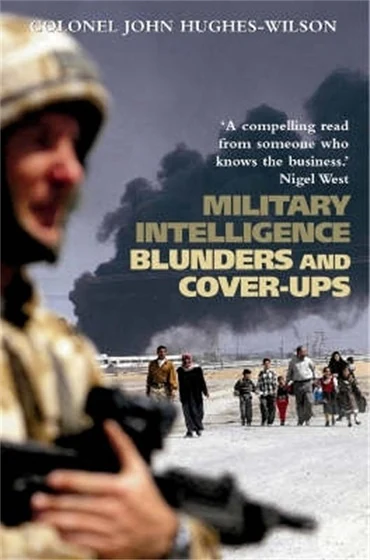
That gap — between what an organization knows and what it can act on — is the subject of Military Intelligence Blunders and Cover-Ups. Colonel John Hughes-Wilson worked through a long sequence of surprises — Barbarossa, Pearl Harbor, Singapore, Dieppe, D-Day, Tet, the Yom Kippur War, the Falklands, the Gulf, and 9/11 and Iraq in this revised edition. In nearly every instance the raw material was already inside the system, and was discounted, delayed, diluted or disowned.
Falcone featured Hughes-Wilson's On Intelligence in September 2023; the two do different jobs. That one surveys the history of espionage and the secret state. This one is narrower and more useful to a risk audience: a study of what happens to good information inside imperfect institutions.
What the book actually covers
Hughes-Wilson organized his argument around the intelligence cycle — direction, collection, processing, dissemination — and argued that failures cluster at the far end. Collection is the glamorous part and the part most often blamed, but it is rarely where things break. The breakages happen in collation, in interpretation, in the passage of an assessment upward, and in the reception it meets on a desk that prefers a different answer.
Pearl Harbor is his set piece for fragmentation: the indicators existed, but sat across services that never assembled them into one picture. Individuals were blamed afterwards — Kimmel and Short conspicuously so — but the failure was in the wiring between them.
The Yom Kippur War supplies the case for analytical lock-in. Israeli military intelligence held a settled view of the conditions under which Egypt would go to war, and it proved strong enough to absorb contradictory evidence rather than be revised by it. Analysts who read the indicators differently were outranked by consensus — the most instructive kind of failure, produced by capable people applying a coherent method.
The Falklands and Tet chapters shift the emphasis toward incentive. Assessments do not travel through neutral space: they move through organizations where being right about an unwelcome development carries a cost. In the Tet chapter that pressure becomes arithmetic, with headline enemy-strength figures negotiated between agencies holding different equities.
The cover-ups of the title concern the aftermath: pressure applied to assessment once it becomes politically load-bearing, and the reflex to recast a failure as an absence of information rather than a refusal to accept it. Hughes-Wilson wrote as a former practitioner, which shows in his patience with analysts and his impatience with the layer above them.
Why it matters for your risk posture
Read it for the diagnosis of dissemination. Most organizations spend on collection: monitoring, screening, hotlines, external intelligence. Few can say what happens to a well-founded warning between the person who forms it and the person with authority to act. That path, not the sensor, is where the loss occurs.
Read it because the failures described are not failures of competence. Every case involves professionals who were paying attention. The mechanisms that defeated them — a prevailing view too strong to dislodge, an escalation route with a career cost attached, an assessment softened at each retelling — are ordinary features of large organizations, recognizable in compliance functions and family office governance.
Read it for the questions it forces about your own reporting lines. How is a dissenting view preserved as it travels upward? Who is permitted to be skeptical in front of the principal? What happens, in practice rather than in policy, to a report that contradicts a decision already taken? The book supplies pathology rather than framework. That is the more durable contribution.
Key takeaways
- Collection is rarely the binding constraint. The warning usually existed already. What was missing was a route to a decision-maker willing to receive it.
- Settled analytical views resist evidence. A coherent consensus absorbs contradictory signals more efficiently than a weak one, making strong analysis a risk factor as well as an asset.
- Incentives degrade assessment before anyone lies. Where accurate but unwelcome findings carry a professional cost, reporting weakens quietly and without conscious distortion.
- The cover-up is a predictable second stage. Institutions recast a reception failure as an information failure, so post-incident reviews often investigate the wrong question.
About the author
Colonel John Hughes-Wilson served some twenty-five years with the British Army's Intelligence Corps and as a Special Forces operations officer, with active service in the Falklands, Cyprus, Arabia and Northern Ireland. Later appointments included senior British intelligence officer and head of policy at SHAPE, and a post on NATO's International Political Staff.
After leaving the Army he established himself as a military historian, broadcaster and lecturer, speaking to governmental, academic and professional audiences until his death in 2025. His other nonfiction has included Blindfold and Alone, written with Cathryn M. Corns, plus A Brief History of the Cold War and On Intelligence.
Military Intelligence Blunders and Cover-Ups by Colonel John Hughes-Wilson, Constable, 2004.
Beyond the Book
Colonel John Hughes-Wilson (1944–2025) - career military intelligence officer turned historian of how intelligence goes wrong
- A practitioner, not a spectator. A career inside assessment work shows: he treated the analyst sympathetically and reserved his criticism for the layer consuming the product.
- The second Hughes-Wilson title featured here. Falcone covered On Intelligence in September 2023: that book explains how the machinery is meant to work; this one explains why it does not. Read them in that order.
- Check which edition you buy. The book has been revised more than once, and later editions carry material the original could not.
- Read alongside: Roberta Wohlstetter's Pearl Harbor: Warning and Decision, the definitive treatment of signal against noise, and Richards J. Heuer Jr.'s Psychology of Intelligence Analysis for the cognitive mechanics underneath.
Get your copy
Get your copy
Order Military Intelligence Blunders and Cover-Ups on Amazon: find it here.