
Most writing about money laundering is written for compliance officers, and it is organised around obligations: what you must check, what you must report, when you must escalate.
This book is organised around the opposite question. It was written for investigators, and it asks how the money actually moves — because you cannot recognise a structure you have never had explained to you.
For anyone doing financial investigations, asset tracing or serious counterparty work, that difference in orientation is the whole value.
What the book actually covers
Madinger spent a career in federal financial investigation, and the book reflects the working method rather than the regulatory one.
He starts with the underlying logic. Laundering exists to solve a specific problem for the criminal: illicit proceeds that cannot be explained. The classic three-stage model — placement of the cash into the system, layering through transactions to obscure origin, integration back into apparently legitimate assets — is the framework, and Madinger works through the techniques used at each stage in detail.
The techniques are the substance. Structuring deposits below reporting thresholds. Cash-intensive front businesses used to commingle proceeds with real revenue. Trade-based laundering, where the mispricing of goods moves value across borders under the cover of ordinary commerce. Shell and nominee structures across cooperative jurisdictions. Professional intermediaries — lawyers, accountants, company formation agents — used to create distance and respectability.
The investigative half is where it distinguishes itself: how to construct a financial profile of a subject, how the net worth method works to demonstrate unexplained wealth, how to follow funds across institutions and borders, and how to build a case that survives contest.
It is written as a working manual for people conducting investigations, and it reads like one — organised, methodical and specific.
Why it matters for your risk posture
Read it because recognition requires prior knowledge. Trade-based laundering, in particular, is invisible to anyone who does not know the technique exists — it looks like ordinary commerce with slightly odd pricing. The same is true of nominee structures and of commingling through legitimate businesses. You cannot spot what you cannot name.
Read it for the net worth method, which is a genuinely transferable analytical tool. Establishing that a subject's assets and expenditure exceed any plausible legitimate income is the foundation of most financial investigation, and it is applicable well beyond criminal work — to executive background matters, to counterparty assessment, and to any situation where a stated financial picture needs testing.
And read it as the systematic counterpart to the narrative accounts. The financial-crime memoirs give you one case in depth; this gives you the taxonomy those cases are instances of. For a practitioner, the taxonomy is the more useful possession.
Key takeaways
- Placement, layering, integration. The three-stage model is the map, and each stage has its own recognisable techniques and its own detection opportunities.
- Trade-based laundering hides inside legitimate commerce. Mispriced goods moving value across borders is invisible unless you know to look for it.
- The net worth method tests the stated picture. Assets plus expenditure against plausible legitimate income is the foundational analytical move.
- Professional intermediaries create distance and respectability. The lawyer, accountant or formation agent in the chain is a feature of the structure, not incidental to it.
About the author
John Madinger spent his career in United States federal financial investigation, including extended service in criminal investigation work focused on money laundering and financial crime. The book is drawn from that practical experience and from the training material developed for investigators.
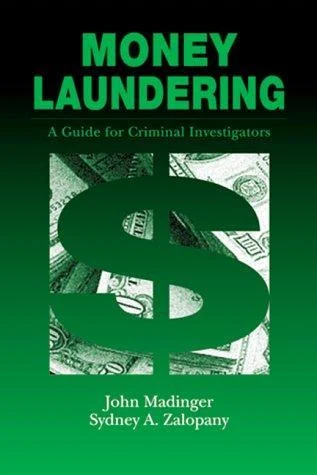
Money Laundering: A Guide for Criminal Investigators has been through multiple editions and is used both as a working reference and as a training text for financial investigators. It occupies a distinct position in the literature: written for the person conducting the investigation rather than the person filing the report.
Beyond the Book
John Madinger — federal financial investigator (ret.)
- Get the most recent edition. The core typologies are stable, but the virtual-asset and cryptocurrency material is where editions diverge most, and an old edition will be materially incomplete on it.
- The current authoritative source: FATF publishes typology reports and guidance at no cost, and these are the live update on emerging laundering methods. For anything post-dating your edition, that is where to look.
- The narrative companion: Dirty Dealing by Peter Lilley covers similar ground for a general reader if you want the argument before the manual.
- Read alongside: How Spies Think by David Omand, for the analytical discipline to apply to what a financial investigation surfaces.
Get your copy
Get your copy
Order Money Laundering: A Guide for Criminal Investigators on Amazon: find it here.