
Consider a consignment of scrap metal that leaves one port invoiced at several times its market value. The buyer pays in full, against documents a trade finance desk would clear without pause. A large sum has crossed a border and changed hands, and nothing in the payment looks irregular. The value traveled inside the price.
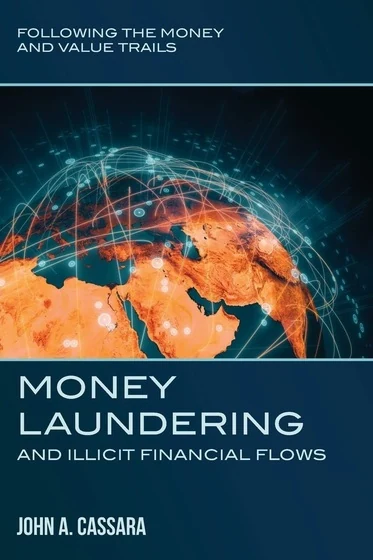
That mechanism - value transfer rather than money transfer - is the organiizing idea of John Cassara's Money Laundering and Illicit Financial Flows. Cassara spent a 26-year government career as a US intelligence officer and then a Treasury special agent working money laundering and trade fraud cases. The book reads like the debrief: a survey of how criminal proceeds move, written from the enforcement side rather than the compliance side.
Enforcement and compliance do not see the same picture. Anti-money laundering regimes were built around the banking channel and the wire transfer; most of what Cassara catalogues goes around them, sitting instead in trade documents, agents, freight and commodities - which belong to procurement and operations, not the financial crime team.
What the book actually covers
Organiized by methodology rather than by regulation, the book works as a reference. Cassara covers bulk cash smuggling, shell companies, correspondent banking, money service businesses, real estate, gold, illicit tobacco and cyber-enabled channels, with more than twenty case studies and a long section on China. It is a manual, not an argument.
The strongest material is on trade-based laundering. The techniques are unglamorous - over- and under-invoicing, multiple invoicing of a single shipment, phantom shipments, false description of goods - and none require placing cash in a bank. The mispriced invoice is the transfer, and the volume of world trade provides the cover. Cassara is credited with originating the Trade Transparency Unit, which compares one country's export data with the counterpart's import data so mismatches surface as anomalies rather than allegations.
The hawala chapters make the complementary point. The instruction moves and the money does not; the interesting question is how brokers settle between themselves, and settlement frequently runs through trade, with goods priced to clear the imbalance. These systems carry large volumes of legitimate remittance traffic and are not criminal in themselves. The risk is that they are invisible to a regime watching the regulated channel.
Underneath the taxonomy sits a blunt critique. Cassara weighs the cost of compliance and the volume of reports filed against the share of criminal proceeds actually intercepted, which on widely cited estimates is a fraction of one per cent; his conclusion is that the regime is close to total failure. He argues for proactive enforcement, better use of customs data, and attention to professional facilitators. The book was published independently and shows it in places.
Why it matters for your risk posture
Read it for the map. Most organiizations can describe their payment rails; very few can describe where value crosses a border inside a commercial document - related-party pricing, agent commissions, commodity trading books, barter and offset arrangements. That inventory is where an honest risk assessment starts.
Read it because your investigators and auditors already hold the relevant documents. The typologies convert into questions a procurement audit or a dispute should ask: goods with no observable reference price, invoices raised twice against one shipment, settlement that does not follow the contract.
Read it for the calibration it offers on what an anti-money laundering program buys. Regulatory defensibility and genuine detection are different products, and boards routinely purchase the first while believing they have the second. The executives we work with find that distinction easier to act on once the methods are laid out.
Key takeaways
- Value moves without money moving. Mispriced trade, informal remittance networks and commodities shift value across borders while leaving the regulated payment channel clean.
- Trade is the largest blind spot. Global trade volume lets manipulated invoices hide in plain sight, and customs and financial data are rarely compared.
- Settlement is where the systems meet. Informal value transfer networks often balance their books through trade, so the two typologies should be examined together.
- Filing volume is not detection. Compliance activity and interception rates have diverged sharply, and only the second measures whether the regime works.
About the author
John A. Cassara began his government career as an intelligence officer and went on to serve as a Treasury special agent in both the US Secret Service and the US Customs Service, investigating money laundering and trade fraud. Posted to the customs attaché office in Rome, he directed an early cross-border task force aimed at Italian-American organiized crime.
He later spent six years at Treasury's Financial Crimes Enforcement Network and finished his service with Treasury's Office of Terrorism and Financial Intelligence. He has testified before Congress and lectured internationally on value transfer and trade-based laundering.
Money Laundering and Illicit Financial Flows: Following the Money and Value Trails, John A. Cassara, published independently, 2020.
Beyond the Book
John A. Cassara - former US intelligence officer and Treasury special agent, and a persistent critic of the AML regime.
- The specialist companion: Trade-Based Money Laundering: The Next Frontier in International Money Laundering Enforcement (Wiley, 2015), with a foreword by Chip Poncy, gives the trade chapters a full book.
- On terrorist finance: Hide & Seek: Intelligence, Law Enforcement, and the Stalled War on Terrorist Finance (Potomac Books, 2006) covers the institutional failures that recur here.
- The reform argument: he has pressed the case for Trade Transparency Units and for judging programs by outcomes, not activity.
- Read alongside: Moneyland by Oliver Bullough and Kleptopia by Tom Burgis, which follow the same money from the receiving end - the professionals and jurisdictions that take it in.
Get your copy
Get your copy
Order Money Laundering and Illicit Financial Flows: Following the Money and Value Trails on Amazon: find it here.