
A sealed letter in Elizabethan England was a security device, not a wrapper. Folded in sequence, slit, threaded with a strip of its own paper and closed with wax, it could not be opened cleanly. Reading it undetected took tools, materials, a steady hand and time — constraints that decided whether a secret held more often than the cipher inside did.
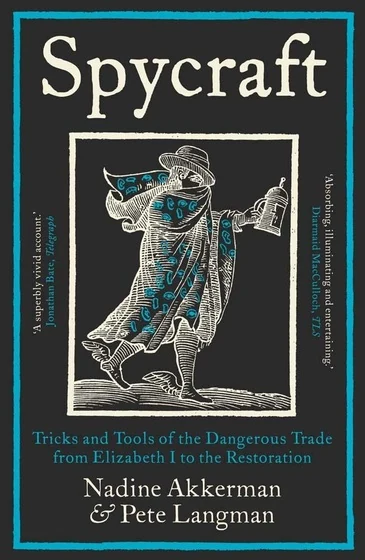
Spycraft: Tricks and Tools of the Dangerous Trade from Elizabeth I to the Restoration examines how intelligence work was performed across roughly a century of English history. Nadine Akkerman and Pete Langman set the plotters aside and study the equipment: ciphers, invisible inks, seals, locks, concealment and poison. It reads less like a spy narrative than a technical manual rebuilt from the archive.
Strip away the ruffs and the horses and the problems are recognizable: moving material through a channel you do not control, detecting interception, authenticating a sender, keeping a method secure once everyone knows how it works.
What the book actually covers
The organization is by technique rather than chronology: secret writing, the chemistry of inks, the sealing and locking of letters, locks and keys, concealment, and the truth behind the period's reputation for poisoning. Familiar figures appear — Francis Walsingham's cipher secretary Thomas Phelippes, Mary, Queen of Scots, the seal-lifter and forger Arthur Gregory, John Thurloe's interception of mail through the Post Office — but as practitioners of a craft, not characters in a drama.
The method distinguishes the book. Recipes were not simply read; the authors reconstructed and tried them, the results reported plainly, failures included. That produces judgments textual analysis cannot reach: which methods were robust, and which worked on a clean bench but failed in a damp saddlebag on a winter road.
Much of this knowledge was never secret. Recipes circulated in printed books of secrets and works of natural magic; Giambattista della Porta's Magia Naturalis was open to any Latin reader, and John Wilkins set out a repertoire of secret writing and signaling in Mercury, or the Secret and Swift Messenger in 1641. What separated a secure channel from a compromised one was discipline in use, not obscurity.
The countermeasure cycle is documented step by step. Seals were lifted, matrices counterfeited, letters opened, copied and refolded by people who had practiced the fold. Ciphers fell to repeated formulae and predictable openings, and more cheaply to seizure of the key from a captured courier or bought servant. Phelippes went further, forging an addition to a letter in the Babington plot. The authors stay skeptical where the mythology is thickest, poison above all, and note that all of it left traces: knife marks, scorching, a mismatched fold.
Why it matters for your risk posture
Read it for the demonstration that controls are moving objects. Every measure described here was answered, usually within a working lifetime. A control assessed once and treated as settled has already begun to decay; the question is not whether it works, but how long it has stood unchanged and who has studied it.
Read it because almost none of the failures here are failures of mathematics. They are failures of handling: keys stored with the messages they protected, couriers chosen for convenience, traffic volumes that made a channel conspicuous, methods reused after they were known compromised. The list would summarize most modern incident reports.
Read it for the forensic argument, which we would put more strongly than the authors do. Technique leaves residue. Evidence that a letter had been opened survived in the paper and the wax, often outlasting interest in the contents — much as the record of who accessed what, when and how now outlives the document itself.
Key takeaways
- Secrecy of method is not security. The recipes were in print and available to both sides; discipline in use protected the channel.
- The countermeasure cycle is centuries old. Seals invited seal-lifting, ciphers invited cryptanalysis, and each defense produced its offense within a generation.
- The weak point was handling, not technique. Keys, couriers, servants and traffic volume account for most compromises here.
- Tradecraft leaves a material record. Interception was caught by examining the object, not the message - as true now of logs and device forensics.
About the authors
Nadine Akkerman has held the chair of Early Modern Literature and Culture at Leiden University since 2022. Her editorial work on the letters of Elizabeth Stuart, Queen of Bohemia, put her in sustained contact with the physical evidence of seventeenth-century letter-writing — folds, seals, inks — and the intelligence traffic it carried.
Pete Langman is a writer and researcher whose work has covered early modern science and Francis Bacon; he is also the author of the espionage novel Killing Beauties.
Together they wrote Spycraft: Tricks and Tools of the Dangerous Trade from Elizabeth I to the Restoration, published by Yale University Press in June 2024.
Beyond the Book
Nadine Akkerman and Pete Langman - two early modern scholars who tested the tradecraft they document
- Akkerman on the agents themselves: Invisible Agents: Women and Espionage in Seventeenth-Century Britain (Oxford University Press, 2018) recovered the women who carried, concealed and decoded correspondence.
- The letter as a security object: scholarship on letterlocking treats the folded, slit and sealed letter as tamper-evident packaging - a useful frame for chain of custody.
- Reconstruction as evidence: the true cost of a method, in time, materials and skill, is visible only when somebody attempts it.
- Read alongside: Christopher Andrew's The Secret World: A History of Intelligence for the institutional arc, and David Kahn's The Codebreakers for the cryptanalytic lineage.
Get your copy
Get your copy
Order Spycraft: Tricks and Tools of the Dangerous Trade from Elizabeth I to the Restoration on Amazon: find it here.