
In May 1860 the Republican convention in Chicago chose Abraham Lincoln, a former one-term congressman from Illinois, out of federal office for eleven years, over three better-known men: William Seward of New York, Salmon Chase of Ohio and Edward Bates of Missouri. What Lincoln did next is the reason this book exists. He appointed all three to his cabinet — Seward at State, Chase at the Treasury, Bates as Attorney General — and later made Edwin Stanton, a Democrat who had once treated him with open contempt, Secretary of War.
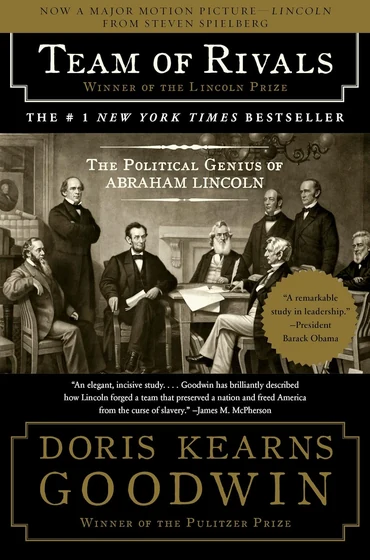
Doris Kearns Goodwin's Team of Rivals is a collective biography of those men and an argument about what it took to hold them together through a civil war. It is history rather than management writing, with no framework at the end — but one of the few detailed accounts of a leader deliberately assembling abler, openly disagreeing subordinates and extracting decisions from them.
That is a narrow skill, and it maps onto the failure mode behind many governance disasters: a senior team that has stopped arguing.
What the book actually covers
Goodwin builds the book in two movements. The first runs the four men's lives in parallel to the 1860 convention, showing how improbable Lincoln's selection was. The second follows the administration to 1865, drawn from the participants' diaries and letters.
The appointments were not sentimental. Lincoln judged that the country was in crisis and the strongest men available were the ones he had beaten; he also needed every faction of a new party inside the tent. The cost was a cabinet in which several members believed they should have had his job, and one who went on working toward it while serving.
Much of the book is therefore about technique. Lincoln absorbed public blame for subordinates' errors and passed credit outward, traveled to see people rather than summoning them, and wrote sharp letters when angry that he then left unsent. He tolerated years of private disloyalty from Chase in exchange for competence at a Treasury financing a war.
The decision-making pattern is worth studying. On emancipation he brought the question to the cabinet after he had made up his mind, wanting their views on execution rather than principle — then accepted Seward's advice to wait for a battlefield success rather than issue it amid military reverses, when it would read as the last measure of an exhausted government. Disagreement was solicited where the question was open; authorship stayed where it belonged.
The title has been over-applied since: not every member of that cabinet was a rival, and the book is more sympathetic to Lincoln than a skeptical reader might want. The compensation is that the evidence sits on the page, in their own words.
Why it matters for your risk posture
Read it for the argument against a comfortable executive team. Boards select for alignment because it is pleasant and fast; the cost appears later, when nobody has an incentive to say the acquisition is wrong or the numbers are being managed. Lincoln's cabinet was slow and unpleasant, and it surfaced problems early.
Read it because it shows how dissent is actually produced. Not by inviting it at a town hall, but by having people in the room whose standing does not depend on the leader's goodwill. Structural independence, not an encouraging tone, makes challenge reliable.
Read it for the trade-off it refuses to hide. Capable dissenters are expensive: they leak, they maneuver, they position themselves. Lincoln drew the line at conduct that damaged the work rather than conduct that damaged him — the practical test for anyone weighing a difficult colleague.
Key takeaways
- Disagreement is a control, not a cost. A team assembled for harmony has no mechanism for detecting its own errors. One assembled for competence and independence does.
- Consult on execution when the principle is settled. Separating the two allows real advice on timing and method without diluting ownership of the decision.
- Independence has to be structural. Challenge is only reliable when the challenger's position does not depend on the person being challenged.
- Tolerate ambition; police damage. The line is whether the behavior harms the work, not whether it wounds the leader — a distinction most organiizations draw the wrong way round.
About the author
Doris Kearns Goodwin is an American presidential historian. She worked in the Johnson White House as a young woman and later assisted the former president with his memoirs, the experience behind her first book, Lyndon Johnson and the American Dream. She taught government at Harvard before writing full time.
She won the Pulitzer Prize for History in 1995 for No Ordinary Time, on the Roosevelts and the American home front in the Second World War. An earlier book, The Fitzgeralds and the Kennedys (1987), was later the subject of an attribution dispute she acknowledged and corrected. Team of Rivals won the Lincoln Prize and became her best-known book; Spielberg's Lincoln (2012) drew on it. The Bully Pulpit (2013) and Leadership in Turbulent Times (2018) followed, and An Unfinished Love Story (2024) returned to the Johnson years through her late husband's papers.
Team of Rivals: The Political Genius of Abraham Lincoln, by Doris Kearns Goodwin, Simon & Schuster, 2005.
Beyond the Book
Doris Kearns Goodwin - presidential historian and biographer
- Trained inside the building. Her early work in the Johnson administration gave her a feel for how a presidential staff functions.
- Diaries as primary evidence. The book's authority rests on private journals and letters, which is why the personalities read as people, not statues.
- A long project on temperament. Johnson, the Roosevelts, Taft and Lincoln are examined for the same thing: how character meets constraint.
- Read alongside: Goodwin's own Leadership in Turbulent Times, and Joshua Wolf Shenk's Lincoln's Melancholy, for the psychology this narrative leaves implicit.
Get your copy
Get your copy
Order Team of Rivals: The Political Genius of Abraham Lincoln on Amazon: find it here.