
A history piece. Read for 1931, not for now — see the note below.
In 1931 a former United States government cryptologist published a book explaining, in detail, that America had been secretly reading the diplomatic cable traffic of its allies and adversaries for a decade.
He named the countries. He described the methods. He explained how the Japanese codes had been broken during the Washington Naval Conference, and how knowing Tokyo's negotiating floor had allowed the American delegation to hold firm at exactly the right moment.
It was a bestseller. It was also, by any reasonable measure, one of the most damaging disclosures in the history of American intelligence — and it changed the law.
What the book actually covers
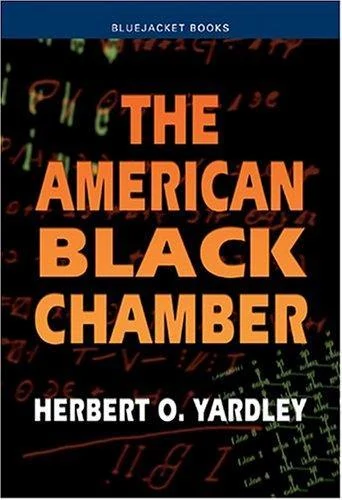
Yardley ran what he called the American Black Chamber — a codebreaking unit funded jointly by the State Department and the Army, operating quietly out of New York after the First World War, reading the diplomatic traffic of a long list of governments.
The book is his account of it: how the unit was created, how the codes were attacked, what was learned, and what it was worth. The Washington Naval Conference material is the centrepiece and remains genuinely instructive — a negotiation in which one party knew the other's fallback position in advance and behaved accordingly. Anyone who has ever wondered what perfect information is actually worth in a negotiation has a case study here.
Then in 1929 the Secretary of State, Henry Stimson, shut the operation down. The line attributed to him — that gentlemen do not read each other's mail — has outlived everything else about the episode.
Yardley, out of work in the Depression, wrote it all down.
What happened next
The consequences were substantial and rapid.
Japan, having learned from the book that its diplomatic codes were being read, replaced them. American cryptologists lost access and spent years rebuilding a capability that had taken a decade to develop.
The United States Congress responded in 1933 by passing legislation making it a criminal offence to disclose foreign government codes or material obtained from them — an act framed directly by this book, and a foundational piece of American secrecy law.
Yardley's own reputation never recovered inside the profession. William Friedman, who became the dominant figure in American cryptology, regarded the disclosure as a betrayal, and Yardley spent the rest of his career at the edges of the field.
That is the arc worth taking from it: a capable insider, dismissed and financially exposed, converted institutional knowledge into a commercial product, and the damage was measured in years.
Why it matters for your risk posture
Read it as the founding insider-disclosure case. The elements are all there and all recognisable: genuine expertise, a termination handled without regard to what the person carried in their head, financial pressure, no enforceable constraint, and a receptive market for the material. Every modern version of this problem is a variation on the same structure.
Read it for the negotiation material, which is the transferable part. The Washington Conference chapters are a rare documented account of what asymmetric information is actually worth at a negotiating table — and, read from the other side, an argument for assuming your own position may be less private than you believe.
And read it as a period document, which is what it is. The tradecraft is a century obsolete. The institutional lesson is not.
Key takeaways
- The knowledge leaves with the person. Document control protects documents. Yardley took nothing but what he knew, and it was enough.
- How a termination is handled is a security decision. A capable person dismissed carelessly and left financially exposed is a risk profile, not a personnel footnote.
- Asymmetric information is worth more than most negotiators assume. The Naval Conference chapters quantify it about as clearly as any account ever has.
- Read the date on the cover. The methods here are a century out of date. Anyone treating this as current tradecraft is badly mistaken.
About the author
Herbert Osborn Yardley was born in Indiana in 1889 and began his career as a telegrapher, joining the State Department code room and there discovering how weak American cryptographic security was. During the First World War he headed the Army's cryptologic section, and afterwards led the joint State-Army codebreaking unit he later called the American Black Chamber.
The unit was closed in 1929. The American Black Chamber was published in 1931 and became an international bestseller, translated widely — including, inevitably, into Japanese.
He later worked as a cryptologic adviser abroad, including in China and Canada, and wrote further books, among them a well-regarded volume on poker. He died in 1958 and is buried at Arlington.
Beyond the Book
Herbert O. Yardley — 1889–1958
- A caution on the text itself. Yardley wrote from memory, in a hurry, for a commercial publisher, about work he could not document. Historians have found exaggerations and errors throughout. Read it as testimony from an interested party, not as record.
- The corrective: David Kahn wrote a full scholarly biography of Yardley, and it is the standard account of what he actually did. Kahn's The Codebreakers remains the definitive general history of cryptology.
- The legal legacy is live. The 1933 statute passed in response to this book remains part of the American secrecy framework, which makes the episode more than a curiosity.
- Read alongside: Crisis of Conscience by Tom Mueller, covered here — the modern literature on what makes an insider speak, and what organisations do to the people who do.
Get your copy
Get your copy
Order The American Black Chamber on Amazon: find it here.