
Michael Hayden ran the National Security Agency and then the Central Intelligence Agency. His career was built on a premise he had never had cause to examine: that if you established what was true and presented it competently, decision-makers would act on it.
This book is what he wrote when that premise stopped holding. Its subject is not any particular adversary. It is the degradation of the shared factual ground that any intelligence assessment depends on — and what an organisation does when the report is no longer the end of the argument.
What the book actually covers
Hayden's argument is that intelligence work rests on an epistemological contract: analysts establish facts as best they can, express uncertainty honestly, and the recipient treats the assessment as an input to a decision. That contract requires the recipient to accept that facts exist independently of preference.
He describes what happens when it fails — when assessments are received as partisan artefacts, when the analytic process itself is publicly attacked, and when contradictory information is available in sufficient volume that anyone can assemble a version of reality that suits them.
The Russian interference material is the technical core, and it is instructive independent of the politics. Hayden describes an operation whose objective was not to make anyone believe a specific falsehood, but to degrade confidence in the possibility of knowing anything reliably. A population that trusts nothing is easier to manipulate than one that believes the wrong thing, because it has no basis on which to be corrected.
He is candid about the intelligence community's own contribution to its credibility problem, and the Iraq weapons assessments sit heavily over the whole book.
This is a book by a participant with strong views, published in 2018 into a live political argument, and it should be read as such.
Why it matters for your risk posture
Read it for the information-environment problem, which is now a live corporate risk rather than a geopolitical abstraction. Organisations face coordinated reputational attacks that do not attempt to establish a competing truth so much as to make the question feel unresolvable. Recognising that the objective is confusion rather than persuasion changes how you respond to it.
Read it for the assessment-delivery lesson. Hayden's professional crisis is one every investigator eventually meets: a well-sourced, carefully hedged finding delivered to a recipient who does not want it. His account of how that failure actually unfolds — and how the analyst's instinct to add more evidence makes it worse — is useful to anyone who reports findings for a living.
And read it for the honesty about institutional credibility. Hayden accepts that the intelligence community damaged its own standing and that the damage constrained what it could later achieve. The same is true of any advisory function: credibility is a depleting asset, and it is spent on the assessments you get wrong.
Key takeaways
- Confusion is a distinct objective from deception. An operation designed to make people doubt everything defeats correction, because there is no shared basis to correct from.
- More evidence does not fix a contested finding. When the dispute is about framing, additional documentation is read as advocacy. The response has to be different in kind.
- Credibility is a depleting asset. It is spent on the assessments you get wrong, and it constrains everything you can achieve afterwards.
- Read the author's position into the argument. A participant writing in the middle of the dispute he is describing. Valuable, and not neutral.
About the author
General Michael V. Hayden is a retired four-star United States Air Force officer who served as Director of the National Security Agency from 1999 to 2005 and as Director of the Central Intelligence Agency from 2006 to 2009, having also been the first Principal Deputy Director of National Intelligence. He is the only person to have led both the NSA and the CIA.
After leaving government he became a visiting professor at George Mason University, where the Michael V. Hayden Center for Intelligence, Policy and International Security was founded, and worked as a national security analyst for CNN.
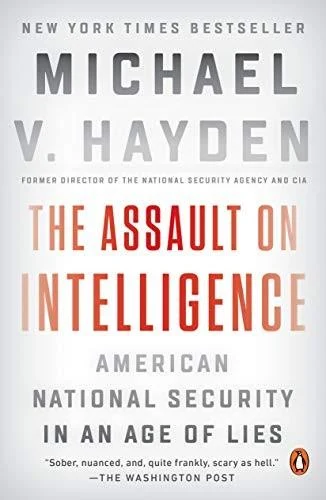
The Assault on Intelligence: American National Security in an Age of Lies was published in 2018. His earlier memoir, Playing to the Edge, covers his time in both agencies and is the more substantial book on the institutions themselves.
In November 2018, months after this book appeared, Hayden suffered a stroke at his home and was hospitalised.
Beyond the Book
General Michael V. Hayden — former Director, NSA and CIA
- Read the memoir instead, if you want the institutions: Playing to the Edge: American Intelligence in the Age of Terror is the fuller account of running both agencies, and is less bound to a single political moment.
- The Hayden Center at George Mason University was founded to run public programming on intelligence and policy, much of it recorded and freely available. That is the accessible version of the subject matter.
- Read alongside: How Spies Think by David Omand — the same discipline, described by a British practitioner, with the analytical method rather than the political argument in the foreground.
Get your copy
Get your copy
Order The Assault on Intelligence on Amazon: find it here.