
Between 2001 and 2002 a run of American corporate collapses — Enron and WorldCom the most cited — turned accounting fraud into front-page news. The explanation on offer was largely about character: a few greedy executives, some bad apples. David Callahan's argument, published two years later, is that this account is comforting and wrong.
The Cheating Culture is not really a book about fraudsters. It is about the conditions under which ordinary people conclude that bending the rules is the sensible thing to do, and why those conditions became so much more common in the United States after 1980. Callahan moves across doping in sport, plagiarism in universities, tax evasion, padded legal bills and conflicted auditors, finding a similar structure under each.
For anyone assessing exposure inside an organiization, the structural reading is the useful one. Screening for bad character has limited returns; most of the people who eventually cause a serious loss would have passed.
What the book actually covers
Callahan's central claim is that cheating became more widespread and more normaliized over roughly a quarter of a century, and that the cause is structural rather than moral decline. The rewards for winning grew enormously, and with them the penalty for placing second, while the older restraints on that impulse weakened.
He divides the behavior into two populations. The Winning Class has the resources, advisers and legal cover to cheat at low personal risk, and the most to gain from doing so. The Anxious Class is not getting rich but is trying to hold its position in a less forgiving labor market, and cuts corners defensively rather than greedily. The two are policed with very different intensity.
The link between them is what he calls trickle-down corruption: when people at the top break rules and keep their gains, the legitimacy of those rules collapses below. Alongside it he traces the erosion of professional self-regulation. Accountancy, medicine and law were once governed partly by commercially inconvenient guild norms, and once those professions were reorganised around revenue targets the norms lost their sponsor. Auditors who had become consultants to their audit clients are his clearest case.
Enforcement is the fourth strand. The resources available to regulators and tax authorities fell behind the scale of what they were expected to police, so the practical probability of being caught — the number that actually enters a rule-breaker's calculation — fell even as formal rules multiplied. Rules without detection do not deter; they teach people which behaviors to disguise. The remedies that follow are the weaker half of the book, and the examples are firmly early-2000s American; the diagnosis has aged far better.
Why it matters for your risk posture
Read it for the reframing of who cheats. The dominant model of misconduct is still the anomalous individual, which makes vetting and character judgment the primary controls. Callahan's alternative is that misconduct clusters where incentives make it rational, and that the structure keeps producing it after the individual has gone.
Read it because it puts detection probability at the center. Codes, attestations and annual training measure activity, not deterrence; what changes behavior is a credible belief that irregularities will be found and traced. A control framework that has outgrown the capacity to test it is the configuration he describes.
Read it for what it implies about the top of the house. Trickle-down corruption turns small executive indulgences — expenses treated loosely, a policy waived for someone senior — into legitimiizing precedents. The exposure is not the indulgence; it is the message to everyone who noticed.
Key takeaways
- Structure predicts better than character. Where rewards are steep and detection is weak, misconduct appears reliably regardless of who is hired.
- Two populations, two motives. Cheating to win and cheating to survive need different controls, and organiizations routinely apply the same one to both.
- Perceived odds of detection do the deterring. The rulebook barely enters the calculation; the believed likelihood of discovery is what moves it.
- Elite exceptions are read as permission. A waiver granted at the top is the cheapest way to teach an organiization that its rules are negotiable.
About the author
David Callahan is an American writer on public policy, inequality and ethics. He holds a doctorate in politics from Princeton and was a fellow at the Century Foundation before co-founding Demos, a New York think tank, at the end of the 1990s. The book reads as social diagnosis rather than business commentary, which is much of its value to a corporate audience.
He returned to related themes in The Moral Center (2006) and Fortunes of Change (2010), then founded Inside Philanthropy and wrote The Givers (2017), on the influence of large private philanthropy over public decisions. The through-line: how concentrated advantage changes the rules everyone else plays by.
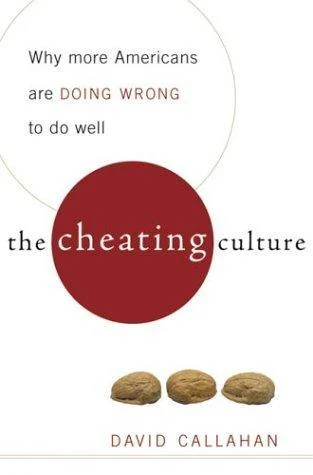
The Cheating Culture: Why More Americans Are Doing Wrong to Get Ahead, by David Callahan, Harcourt, 2004.
Beyond the Book
David Callahan - policy writer on inequality, ethics and the uses of wealth
- Think tank rather than newsroom. He came to the subject through policy research, which is why the book leans on structural evidence rather than portraits of fraudsters.
- One thesis across four of these books. From cheating to philanthropy, the four titles above turn on the same question: how advantage at the top reshapes the rules below it.
- Written as the compliance build-out began. It appeared eighteen months after Sarbanes-Oxley and well before the post-2008 regulatory expansion, which makes its skepticism about rules without enforcement look prescient.
- Read alongside: Eugene Soltes's Why They Do It, on the minds of convicted executives, and Donald Cressey's Other People's Money, the study that produced the fraud triangle.
Get your copy
Get your copy
Order The Cheating Culture: Why More Americans Are Doing Wrong to Get Ahead on Amazon: find it here.