
An accounting discrepancy of seventy-five cents.
That is where it started. An astronomer working as a systems administrator at Berkeley in 1986 was asked to resolve a trivial imbalance in the computer usage accounts. Rather than writing it off, he traced it — and found an intruder inside the network who had come from West Germany and was selling what he found to the KGB.
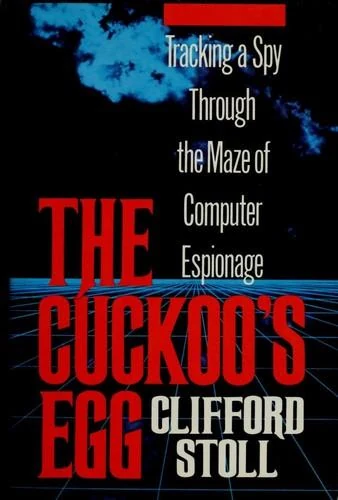
The Cuckoo's Egg is Clifford Stoll's account of that pursuit. It is the founding text of intrusion investigation, and it is still the best argument in print for not ignoring the small anomaly.
What the book actually covers
Stoll was not a security professional. He was an astronomer given systems administration duties, and he approached the discrepancy the way a scientist approaches an unexplained result: as something that must have a cause.
The investigation that follows is documented in almost obsessive detail, and the detail is the value. He builds monitoring to observe the intruder without alerting him. He keeps a meticulous logbook — every session, every command, every timing — which becomes the evidentiary record. He works out how the intruder is escalating privileges and moving laterally between systems. He constructs a honeypot: fabricated documents designed to hold the attacker online long enough for a trace to complete.
The institutional half is as instructive as the technical one, and considerably more frustrating. Stoll's attempts to interest the FBI, the CIA, the NSA and the Air Force in what he has found run into a wall of jurisdictional uncertainty and indifference. Nobody owned the problem, because in 1986 the problem did not yet have a category. Anyone who has tried to escalate a novel risk inside a large organisation will recognise every conversation.
The intruder was eventually identified as part of a group in Hannover selling access and material to Soviet intelligence.
Why it matters for your risk posture
Read it for the anomaly discipline, which is the central lesson and the most transferable one. A seventy-five-cent discrepancy was the visible edge of a state-sponsored espionage operation. The magnitude of an irregularity tells you almost nothing about the magnitude of what produced it, and the instinct to write off the small unexplained thing is the single most reliable way to miss the large one.
Read it for the investigative method, which predates the profession and holds up remarkably well. Observe without alerting the subject. Document contemporaneously and completely. Understand the intruder's objective before intervening. Preserve evidence in a form that will survive scrutiny. These remain the fundamentals.
And read it for the escalation problem. Stoll's difficulty was never technical; it was getting an institution to accept ownership of a risk that did not fit an existing category. That is a permanent feature of emerging threats, and the book is an unusually honest record of what it costs.
Key takeaways
- The size of the anomaly is not the size of the cause. Seventy-five cents led to a KGB-linked espionage operation. Investigate the unexplained, not the large.
- Observe before you intervene. Stoll's decision to watch rather than lock the intruder out is what produced the attribution.
- Contemporaneous documentation is the case. The logbook is what made the findings usable by anyone else.
- Novel risks have no institutional owner. Expect the escalation to be harder than the investigation, and plan for it.
About the author
Clifford Stoll is an American astronomer who became, entirely by accident, the first person to conduct and document a full computer intrusion investigation. At the time he was working in systems administration at Lawrence Berkeley National Laboratory.
He wrote up the case first as a technical paper and then as this book, published in 1989. He subsequently wrote Silicon Snake Oil, a sceptical account of early internet enthusiasm, and High-Tech Heretic, on technology in education — both of which are contrarian in ways that have aged unevenly, and which he has been good-humoured about.
He has since been known for teaching, for public speaking on science, and for manufacturing Klein bottles — glass objects with no inside or outside — which is either a non sequitur or entirely in character, depending on how you read him.
Beyond the Book
Clifford Stoll — astronomer and author
- The original paper is public. Stoll's write-up of the case in the technical literature predates the book and is freely available. For a security reader it is the more rigorous version.
- His talks have circulated widely. Stoll has lectured publicly on science, curiosity and the investigation, and he is a genuinely unusual speaker.
- His other books: Silicon Snake Oil is the sceptical counterweight to 1990s internet optimism, interesting now mostly as a record of what an intelligent contrarian got right and wrong.
- Read alongside: How Spies Think by David Omand for the analytical framework, and The Gift of Fear by Gavin de Becker — both, like Stoll, arguing that the signal was available before the event.
Get your copy
Get your copy
Order The Cuckoo's Egg on Amazon: find it here.