
In 1942 a very tall, badly injured RAF pilot arrived at the British Embassy in Washington as assistant air attaché. The job description was aviation liaison. The real assignment was dinner parties: to charm his way into the houses of newspaper proprietors, senators and the Vice President, and report what was said to a British intelligence office in Rockefeller Center.
The pilot was Roald Dahl, two decades before Charlie and the Chocolate Factory. The Irregulars is Jennet Conant's account of British Security Coordination, the organiization Britain ran on American soil to shape American opinion and policy in Britain's favor.
For anyone whose job is exposure, this is the most useful kind of intelligence history. Almost nothing in it involves lock-picking or codebreaking. It is about access, flattery, patronage and placed stories — methods that still work, because they exploit the social machinery of elite life rather than the defenses around it.
What the book actually covers
Conant sets out the strategic problem: Britain needed American materiel, shipping and eventually troops from a country whose public opposed another European war, and whose Congress reflected it. British Security Coordination, run from Rockefeller Center by the Canadian businessman William Stephenson, existed to change the political weather — countering isolationist propaganda, placing stories, commissioning polls, and collecting intelligence on the people who mattered.
Dahl arrived almost by accident. He had crash-landed in the Western Desert in 1940, was invalided out of operational flying, and initially loathed Washington. What changed it was a magazine piece about the crash, written after meeting the novelist C. S. Forester, which was published anonymously but paid well and marked the start of his writing career — and an introduction to Charles Marsh, a Texas newspaper owner and fixer in whose house powerful people relaxed.
Through Marsh, Dahl reached Vice President Henry Wallace, and the book's central lesson sits there. Wallace talked freely about his post-war thinking, including proposals touching the future of the European colonies and of civil aviation, both cutting against British interests. Dahl reported it, Stephenson passed it up, it reached Churchill. Wallace was not recruited, blackmailed or deceived. He was befriended, in a house where he believed himself among friends.
Conant works from letters, diaries, BSC's internal history and interviews, writing social history because that is where the operation happened. She is careful with her protagonist: Dahl was a practiced embellisher whose war stories improved with retelling, and she flags where his version cannot be trusted. The supporting cast — Ian Fleming, David Ogilvy, Ivar Bryce, Noël Coward — shows how much of the work fell to writers and admen whose trade was already persuasion.
Why it matters for your risk posture
Read it for a working model of an influence operation that breaks no locks: almost nothing here would trip a security team. The method is access — an introduction, a standing invitation, a friendship with someone flattered by the attention. Most of your controls point elsewhere.
Read it because the productive sources were not agents. Wallace and Marsh were assets in no formal sense; they were talking where it felt private. The modern equivalent is the board member at a conference dinner, the adviser who enjoys being consulted, the executive explaining a deal timetable to an interested new acquaintance.
Read it for the reminder that allies collect too. Britain ran this campaign on the soil of the country it most needed as a friend. When listing who has an interest in your intentions, do not stop at competitors and the obviously hostile.
Key takeaways
- Influence operations run on access, not burglary. The entry points were an introduction, a dinner invitation and a patron — none of which trips a control built for intrusion or theft.
- The most productive sources do not know they are sources. Unwitting disclosure by well-placed, well-meaning people did more work here than any recruited agent.
- Social settings are collection environments. The dinner, the conference bar and the charity board are where useful material moves, because nobody there feels they are at work.
- Shared interests are not identical interests. An ally with real goodwill still has its own objectives, and will collect against yours where they diverge.
About the author
Jennet Conant is an American journalist and non-fiction author, born in 1959, granddaughter of James B. Conant, the Harvard president who was among the senior administrators of the American wartime scientific effort — a connection that runs through her subject matter.
She read political theory at Bryn Mawr, trained in journalism at Columbia, spent seven years at Newsweek and has written for Vanity Fair, Esquire and The New York Times. Her books include Tuxedo Park (2002), 109 East Palace (2005) on Los Alamos, A Covert Affair (2011) on the Childs in the OSS, and Man of the Hour (2017), a biography of her grandfather. Her subject is where science, secrecy and personality meet.
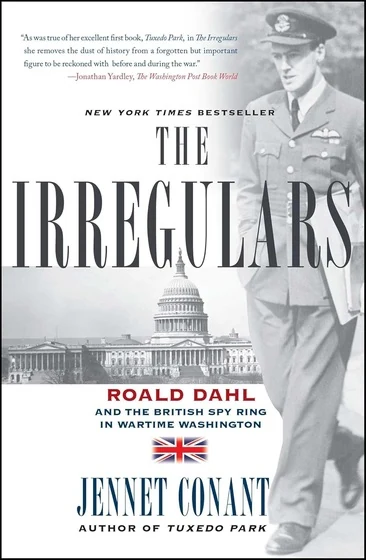
The Irregulars: Roald Dahl and the British Spy Ring in Wartime Washington by Jennet Conant, published by Simon & Schuster, 2008.
Beyond the Book
Jennet Conant - journalist and historian of wartime science and secrecy
- Read it as a taxonomy of access routes. List the entry points Dahl used — war record, introduction, patron, hostess, commissioned article — then check which are open around your principals.
- Note who did the work. BSC used writers, admen and socialites rather than career officers: the task was persuasion, not tradecraft.
- Dahl is an unreliable narrator. Conant says so plainly — a useful demonstration of how to use a self-serving source without discarding or believing it.
- Read alongside: Active Measures by Thomas Rid (2020) and Churchill's Wizards by Nicholas Rankin (2008).
Get your copy
Get your copy
Order The Irregulars: Roald Dahl and the British Spy Ring in Wartime Washington on Amazon: find it here.