
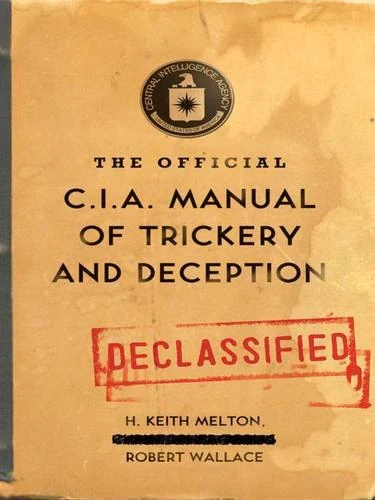
In the 1950s the CIA hired John Mulholland, one of the most accomplished stage magicians in America, to write a manual.
Not about entertainment. About operational technique — how to perform an action while an observer is watching and does not see it, how to direct attention away from what matters, how to make a deliberate act appear accidental. The manuals were believed destroyed. Copies surfaced decades later, and this book reproduces them with historical context.
It is a genuinely strange document, and it is more useful to a security professional than that description suggests.
What the book actually covers
Melton and Wallace — an intelligence historian and a former director of the CIA's Office of Technical Service — supply the context, and the Mulholland material itself forms the core.
Mulholland's insight, which he had spent a career proving on stage, was that deception is fundamentally about managing attention rather than concealing objects. An observer sees what they are directed to see and reconstructs the rest from expectation. The manual works through the practical consequences: how to perform an action in plain sight, how to use natural gesture to cover an intentional one, how the observer's own assumptions do most of the work.
There is material on how to behave inconspicuously, on the tradecraft of appearing to be an ordinary person doing an ordinary thing, and on the psychology of what people actually notice and retain — which is considerably less than they believe.
The historical framing is substantial and is what makes the book publishable rather than merely curious. Melton and Wallace situate the manuals in the Cold War technical-operations context, explain what they were commissioned for, and are appropriately careful about the wider programme they were connected to, which included genuinely troubling activity.
Why it matters for your risk posture
Read it for the attention principle, which is the transferable core. Social engineering works the same way stage magic does: the target is not deceived about a fact so much as directed away from the place where the fact would have been visible. Understanding attention as the medium of deception is what makes pretexting recognisable in progress rather than in hindsight.
Read it for the inconspicuousness material, which is directly relevant to physical security. Mulholland's account of what makes a person unremarkable in a space — and therefore unchallenged — is the same analysis that explains why tailgating and unescorted access work so reliably in corporate environments.
And read it for the reliability lesson about observation. The manual is, incidentally, a sustained demonstration of how poor human observation and recall actually are. For anyone weighting witness accounts in an investigation, that is a useful and slightly uncomfortable calibration.
Key takeaways
- Deception manages attention, it does not conceal objects. The observer sees what they are directed to see and fills in the rest from expectation.
- The target's own assumptions do the work. The most effective deceptions supply a plausible frame and let the subject complete it themselves.
- Inconspicuousness is a technique. Appearing to belong is a set of learnable behaviours, which is why physical access controls fail against confident people.
- Human observation is unreliable in specific, predictable ways. Weight witness accounts accordingly.
About the authors
H. Keith Melton is an intelligence historian and one of the leading authorities on espionage technology and tradecraft, with an extensive collection of intelligence artefacts and a long list of publications on the technical side of intelligence work.
Robert Wallace is a former director of the CIA's Office of Technical Service, the division responsible for the technical support of clandestine operations. Together they have written several books on intelligence tradecraft, including Spycraft, which is the fuller treatment of the technical history.
The book reproduces John Mulholland's manuals, written in the 1950s under CIA commission. Mulholland was among the most respected stage magicians of his era and a serious writer on the theory of magic before the intelligence work.
Beyond the Book
H. Keith Melton & Robert Wallace — intelligence historians
- The fuller book: Spycraft: The Secret History of the CIA's Spytechs is Melton and Wallace's substantial history of intelligence technical operations, and is the more informative of the two for a professional reader.
- A note on context. The manuals originate in a Cold War programme with a genuinely troubling wider history. The techniques are separable from that context and the historical framing here is careful, but the provenance is worth understanding rather than skipping.
- The related literature: Melton's work on tradecraft and espionage technology spans many volumes and is the standard in its field.
- Read alongside: Spy the Lie on detecting deception in an interview, and The Gift of Fear by Gavin de Becker on the manipulation techniques used to build false trust. This book explains the mechanism those two teach you to resist.
Get your copy
Get your copy
Order The Official CIA Manual of Trickery and Deception on Amazon: find it here.