
On the night of 4 August 1964, American commanders reported that North Vietnamese torpedo boats had attacked two US destroyers in the Gulf of Tonkin. The evidence was signals intelligence, and within days Congress had passed the resolution that opened the way to a decade of war. Matthew Aid's reading of the declassified intercept record is that the traffic never described the attack Washington believed had occurred.
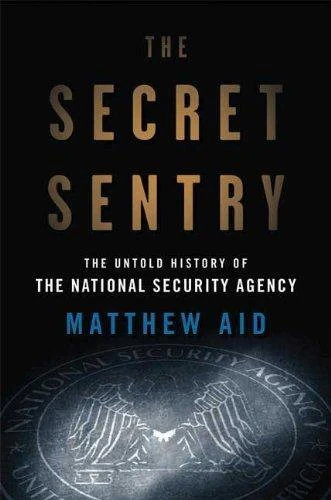
The Secret Sentry is a documentary history of the United States National Security Agency, from the end of the Second World War to the campaigns in Afghanistan and Iraq. It is not a thriller. It is an account, built almost entirely from declassified paper, of what the largest collection apparatus ever assembled actually understood — and of the conditions under which it understood nothing.
That second question is why the book belongs on a risk shelf. Most of the organiizations we work with have spent a decade buying collection: transaction monitoring, endpoint telemetry, screening feeds, whistleblowing lines. Fewer have invested comparably in the capacity to read what arrives. Aid's argument, evidenced at length, is that collecting and understanding are different problems, and the second is much the harder.
What the book actually covers
Aid works chronologically: the wartime cryptologic organiizations, the agency's creation in 1952, Korea, the long Soviet stand-off, Cuba, Vietnam, the Middle East wars, the collapse of the Warsaw Pact, the target-hunting of the 1990s, and the years after September 2001. Each episode is handled the same way — what was collected, what was concluded, and what turned out to be the case. The distance between those three is the book.
The method is archival. Aid spent years filing Freedom of Information Act requests and working through declassified holdings, supplemented by interviews with former officials. The result is dry and heavily sourced, a book of documents rather than of scenes. He also understood how classification behaves in practice: working with the National Security Archive, he helped expose a program under which records previously open to the public had been quietly withdrawn from the US National Archives and reclassified.
The pattern that emerges is uncomfortable. The agency did well against adversaries who were talkative, careless or technically outmatched, and poorly against those who were not. Against disciplined cipher practice, couriers and buried landlines the take thinned to very little — and when a target went quiet, the silence was often read as calm rather than as lost visibility. Volume compounded this: collection outran the linguists and analysts needed to turn intercepts into meaning, so material was gathered, stored and never read.
Aid is equally attentive to the bureaucratic layer. Turf disputes, budget defenses and periodic hunts for relevance shaped what was collected in the first place. The closing chapters are the sharpest. On Iraqi weapons of mass destruction he documents how material the agency's own people regarded as ambiguous was passed onward as corroboration, and he sets out the internal argument over the domestic collection programs that followed September 2001.
Why it matters for your risk posture
Read it because the failure mode is almost never a shortage of data. In many of the episodes Aid reconstructs, the relevant signal existed somewhere in the take; what was missing was the analyst, the queue position, or the willingness to act on an inconvenient reading. Before approving another monitoring tool, ask what share of last year's alerts a human actually understood.
Read it for the discipline it imposes on how you treat silence. A quiet supplier, a subsidiary that stops generating exceptions, a jurisdiction with no adverse media: none of these is evidence of good conduct. Aid shows an organiization repeatedly mistaking its own blind spots for the absence of a threat.
Read it because interpretation bends toward expectation, and only structure decides how far. Tonkin and Iraq are the same failure decades apart: a conclusion formed upstream, then evidence read to fit it. The practical question that leaves is who, in your organiization, can say that the data does not support the conclusion — to whom, and at what personal cost.
Key takeaways
- Collection capacity and comprehension capacity are separate budgets. Aid's NSA was rarely short of intercepts; it was routinely short of people who could read them in time. Assess the second before expanding the first.
- Silence is a reporting artefact, not a finding. Where a counterparty's signal disappears, the honest entry is a visibility gap, not a clean result.
- Analysis inherits the pressure of whoever commissioned it. Both of the failures set out above began with a conclusion that was already politically necessary.
- Hard targets stay hard. Capable adversaries adapt once they understand how they are watched, so a control's usefulness decays from the day it is deployed.
About the author
Matthew M. Aid was born in New York in 1958 and studied international relations at Beloit College. He served in the United States Air Force as a Russian linguist on signals intelligence work, a period that ended with a court-martial for mishandling classified material and a bad conduct discharge, a matter he discussed publicly in later years. He then spent two decades as a corporate investigator before turning to full-time historical research.
In 2005 he became a visiting fellow at the National Security Archive in Washington, where his research exposed the reclassification of records that had previously been open to the public. Alongside The Secret Sentry he wrote Intel Wars (2012) and co-edited a scholarly volume on Cold War signals intelligence. He died in 2018.
The Secret Sentry: The Untold History of the National Security Agency, Bloomsbury Press, 2009.
Beyond the Book
Matthew M. Aid - intelligence historian, former Air Force Russian linguist, and a persistent user of the Freedom of Information Act.
- On the sourcing: the endnotes are much of the value. They point to the declassified holdings the argument rests on, so the reader can go to the documents rather than take the conclusions on trust.
- Companion volume: Intel Wars (2012) applies the same method to counter-terrorism after 2001, and is the sharper book on why volume defeats analysis.
- Read alongside: James Bamford's Body of Secrets (2001) for the institutional portrait, and Kim Zetter's Countdown to Zero Day (2014) for what happens when agencies stop listening and start acting.
Get your copy
Get your copy
Order The Secret Sentry: The Untold History of the National Security Agency on Amazon: find it here.