
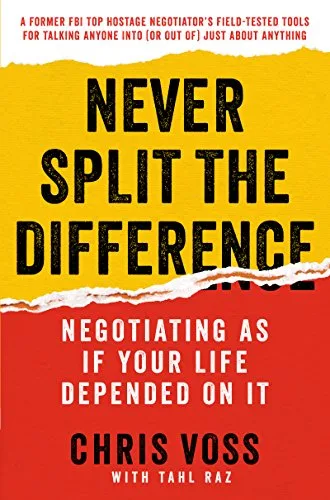
Chris Voss and Tahl Raz ask what a compromise can leave undiscovered when negotiations stall. They argue that meeting in the middle can end the discussion before either party finds out what would make the deal work for both.
Never Split the Difference: Negotiating As If Your Life Depended On It was written by Voss with the journalist Tahl Raz and published by HarperBusiness in 2016. Much of the material comes from Voss's FBI hostage and kidnapping cases.
The underlying claim is that negotiation is driven more by emotion than by rational analysis, and that a counterpart moves once they feel accurately understood. Voss calls the skill of creating that understanding tactical empathy, and the techniques — mirroring, labeling, the deliberate use of "no," the calibrated question — all serve it. He presents it as an alternative to the rational, interest-based model taught at Harvard and made popular by Getting to Yes. The book opens at Harvard itself. Voss is on campus for a short executive course when Robert Mnookin invites him to his office for coffee, and there Mnookin and Gabriella Blum spring a mock kidnapping on him. He answers their ransom demand with a calibrated question: how am I supposed to do that?
What sets the book apart in its genre is where the method comes from. Voss describes how the FBI, after the sieges at Ruby Ridge and Waco ended in loss of life, moved from a bargaining approach to one grounded in psychology and in listening techniques long studied in psychotherapy and crisis intervention. Its crisis negotiators later set that approach out as the Behavioral Change Stairway Model. Voss also cites the research behind the techniques, including Daniel Kahneman's work on fast and slow thinking and a UCLA brain-imaging study showing that naming an emotion dampens the amygdala’s response to it.
Summary
In Never Split the Difference, Chris Voss and Tahl Raz set out the negotiating method Voss used during his FBI career. The authors emphasize the role of emotion in decisions and build their method around mirroring, labeling, the accusation audit and the calibrated question. Voss treats “no” as a starting point, “that’s right” as the sign that the other side feels understood, and a split difference as a compromise that can leave other possibilities unexplored.
What the book covers
The method is built from a small number of moves. Mirroring, repeating the last few words the other party said, keeps them talking. Labeling names the emotion you think you are hearing, usually prefaced with "it seems like," which acknowledges it and lets them correct you if you have read them wrongly. The accusation audit names the negative things they are likely to think about you before they can say them, which defuses them in advance.
Two ideas run against common instruction. The first is that "no" is a beginning rather than an ending: people say no to retain control, and a negotiation that gets a comfortable no is often further along than one that has extracted an anxious yes. The second is that "that's right" — the moment the other party recognizes their own position in your restatement of it — is the real inflection point, and Voss distinguishes it from "you're right," which can signal that the other person is ready to end the conversation.
The calibrated question is the practical core: an open question beginning "how" or "what" that hands the other party the problem without confrontation, as Voss's reply to Mnookin's ransom demand did.
The book also covers the other side of the table. It describes three negotiating styles a counterpart is likely to have, explains how to respond to an extreme opening offer without giving ground, and offers practical tests for telling a real commitment from a "yes" that will not be honored. Its final chapter is about what Voss calls Black Swans: hidden facts that change a deal once they come to light. His working assumption is that each side in a negotiation holds at least three of them.
Implications for risk management
Labeling and mirroring apply well beyond hostage negotiations. Both offer a way to check an interpretation of the other party’s position before acting on it, something that can be equally useful in diligence.
The search for what Voss calls Black Swans also has an application in diligence. Voss finds them by listening closely, preferably face to face, asking calibrated questions and noticing what does not add up, and the same habits serve well when researching a counterparty.
Many of these techniques are now widely taught to business negotiators, so you are likely to meet them across the table, and recognizing them lets you respond calmly rather than by reflex. The methods are easy to describe and harder to do well. Voss treats the voice as the most powerful tool in verbal communication, down to the slow, calm “late-night FM DJ voice” he reserves for making a point.
Voss argues that deadlines can be more flexible than they look. Pressure to close can favor one party over the other, so knowing whose constraint sets the timetable can help a negotiating team decide how much time it has for diligence.
A counterparty’s urgency frequently compresses the time available for diligence on the people behind the deal. Our mergers and acquisitions support is scoped to that timetable, starting from what would change the client’s mind about the deal. Findings on the principals can then reach the negotiating team before the terms are fixed.
Key takeaways
- A midpoint can leave other options unexplored. Voss and Raz argue that meeting in the middle may end a negotiation before either party understands what could make the deal work for both.
- A “no” can move the discussion forward. In Voss’s method, it can give the other party room to explain a concern, while a quick “yes” may leave a commitment unclear.
- How a counterpart agrees can matter. Voss treats “that’s right” as a sign that the other party feels understood. “You’re right” may simply signal that they are ready to end the conversation.
- Calibrated questions transfer the problem without confrontation: how am I supposed to do that?
- A deadline may reflect one party’s constraints. Voss argues that clarifying whose timetable is at stake can give both sides room to consider their options.
About the authors


Chris Voss is the book's lead author and a former FBI lead international kidnapping negotiator, with twenty-four years at the Bureau. He founded The Black Swan Group, a negotiation consultancy, and teaches the method to business audiences.
Tahl Raz is a journalist and co-author whose earlier book with Keith Ferrazzi, Never Eat Alone, was an international bestseller. Never Split the Difference is frequently attributed to Voss alone, which understates the collaboration that produced it.

Where the proceeds go
We donate 100% of what we earn to Children of Fallen Heroes
If you buy through the link above we may earn a small commission, at no extra cost to you. Every penny of it goes to Children of Fallen Heroes, a registered 501(c)(3). We keep none of it.
They are developing an 82-acre campus in Vass, North Carolina for the children of military families, first responders and foster youth — STEAM education in aviation, robotics and drones, alongside leadership and healing programs. Over eleven years their programs have reached more than 15,000 young people and families.
We participate in the Amazon Services LLC Associates Program and similar affiliate programs; these relationships do not influence our recommendations. Cookies and similar technologies record interactions with affiliate links — see our Privacy Policy to disable them, or reach us via Contact.