
David Omand ran GCHQ, served as the UK's first Security and Intelligence Coordinator, and spent a career seeing how intelligence assessments informed national security decisions.
His argument in this book is that the discipline intelligence analysts use to reach conclusions under uncertainty is not specialist knowledge but a transferable method — and it addresses errors that can arise in organizational risk assessments.
Summary
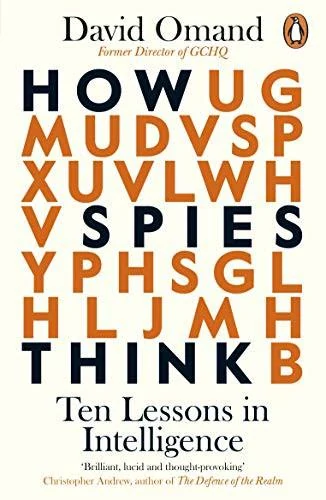
How Spies Think: Ten Lessons in Intelligence is Sir David Omand’s case that analytical tradecraft can be taught to anyone who has to decide under uncertainty. Omand, a former Director of GCHQ, organizes it around a four-part model. Situational awareness establishes what is happening, explanation tests competing hypotheses about why, estimation states what is likely next with explicit confidence, and strategic notice considers developments not yet indicated. He introduces Bayesian reasoning as the discipline of holding a prior and updating it in proportion to new evidence. Warnings drawn from real intelligence failures run through the book, including how deliberate deception is built against an analyst’s expectations. Readers take away a working method for keeping fact apart from inference.
What the book covers
Omand's organizing structure is a four-part model of analysis, taught as a sequence.
Situational awareness. What is happening, established as fact and distinguished carefully from what is assumed. Omand shows how an assessment can go wrong when an inference is recorded as an observation.
Explanation. Why it is happening, which is where the analyst must generate and test competing hypotheses rather than settling on the first coherent story, and where Omand introduces Bayesian reasoning — the discipline of holding a prior estimate and updating it proportionately as evidence arrives, rather than lurching between certainties.
Estimation. What is likely to happen next, expressed with explicit confidence levels so readers can see how much weight the analyst gives the forecast.
Strategic notice. What developments should be anticipated even though they are not currently indicated — the deliberate practice of thinking about what would surprise you, before it does.
Around this he builds a set of warnings drawn from real intelligence failures: the seduction of the confirming detail, the danger of the compelling narrative, the way conspiratorial thinking mimics analysis, and the specific ways deliberate deception is constructed to exploit an analyst's expectations.
The lessons are illustrated with cases from his own career and from the documented record, including the assessments that went badly wrong.
Implications for risk management
Omand’s four-part model also applies to due diligence. A background investigation produces situational awareness; the client needs explanation, estimation and strategic notice. Knowing the difference between those layers is what separates a report that lists findings from one that supports a decision.
Omand’s Bayesian approach can help when assessing a counterparty, a candidate or a market entry. It starts with an explicit estimate and adjusts it in proportion to the evidence, giving a striking new finding only the weight it warrants.
Omand's account of how deliberate deception is engineered against an analyst's expectations is directly applicable to fraud, to sanctions evasion and to any situation where a subject is constructing a picture for you to find. The defense begins with knowing that the picture may have been assembled for your benefit.
Omand separates what is happening from why it is happening, and both from what is likely to follow. We use the same structure in reporting strategic business intelligence, labeling each finding as established, likely or contested so that a board can see how much weight it will bear. Where the evidence supports more than one explanation, the report says so. A client deciding on a market entry or a partner is better served by a stated alternative than by a single coherent story.
Key takeaways
- Separate the four questions. What is happening, why, what follows, and what should be anticipated. Conflating them can obscure where evidence ends and judgment begins.
- Hold a prior and update it proportionately. The single dramatic finding should move your estimate, not replace it.
- Test competing hypotheses, not the first coherent one. A story that explains the evidence is not the same as the story most likely to be true.
- Deception is built against your expectations. A hostile subject may anticipate what an analyst will look for.
About the author

Sir David Omand held senior positions at the Ministry of Defence before serving as Director of GCHQ, then as Permanent Secretary at the Home Office, and from 2002 as the United Kingdom's first Security and Intelligence Coordinator in the Cabinet Office, with responsibility for the professional health of the intelligence community and for national counter-terrorism strategy.
Since leaving government he has taught as a visiting professor in the War Studies department at King's College London, and has written on intelligence, security policy and the ethics of secret intelligence.
How Spies Think: Ten Lessons in Intelligence was published in 2020. Falcone International previously featured it as Book of the Month in June 2023; this review revisits it in the current format.

Where the proceeds go
We donate 100% of what we earn to Children of Fallen Heroes
If you buy through the link above we may earn a small commission, at no extra cost to you. Every penny of it goes to Children of Fallen Heroes, a registered 501(c)(3). We keep none of it.
They are developing an 82-acre campus in Vass, North Carolina for the children of military families, first responders and foster youth — STEAM education in aviation, robotics and drones, alongside leadership and healing programs. Over eleven years their programs have reached more than 15,000 young people and families.
We participate in the Amazon Services LLC Associates Program and similar affiliate programs; these relationships do not influence our recommendations. Cookies and similar technologies record interactions with affiliate links — see our Privacy Policy to disable them, or reach us via Contact.