
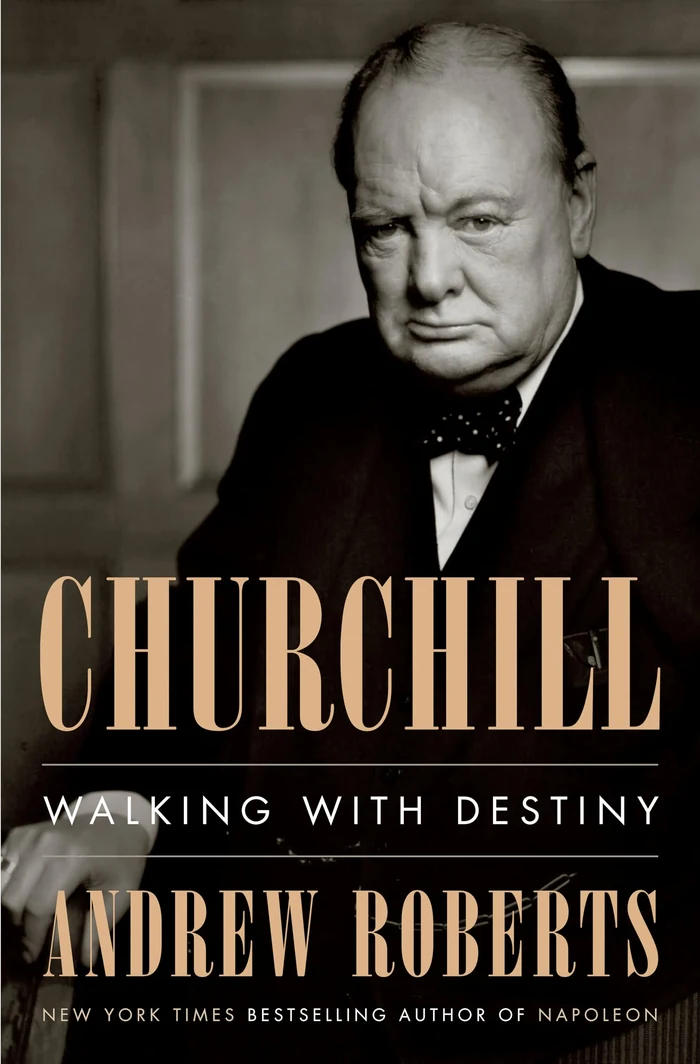
By September 1940, Winston Churchill and George VI were lunching alone on Tuesdays when both were in London. The King recorded their conversations afterward. Andrew Roberts was the first Churchill biographer granted unrestricted access to the King’s wartime diaries in their entirety.
In his account of the diaries, Roberts distinguishes two conversations. Soon after the attack on Pearl Harbor, Churchill criticized the American response to Japanese landings in Southeast Asia. In a later conversation about the danger of a Japanese invasion of Australia, he told the King that the US fleet could have prevented an invasion had it been at sea.
Churchill: Walking with Destiny is a single-volume life running to roughly 1,100 pages, published by Allen Lane in Britain and Viking in the United States in 2018. Roberts draws on more than forty sources unavailable to previous biographers, of which the King's wartime diary is the most consequential. It took the silver medal in the Council on Foreign Relations' 2019 Arthur Ross Book Award.
The title is Churchill’s own phrase for the night of 10 May 1940. Roberts reads the Dardanelles, the return to gold, Churchill’s opposition to Indian self-government and his position on the abdication as part of the political experience he brought to office in 1940.
Roberts makes a persuasive case for reading Churchill’s early setbacks alongside his wartime judgment. His access to the King’s diaries adds to the record, and his interpretations of India and Gallipoli remain open to debate.
What the book covers
The structure is a straightforward chronology running from 1874 to 1965. Roberts moves fast through Harrow, Sandhurst, Omdurman and the South African escape that made Churchill famous at twenty-five, then slows for the decisions that matter: the Admiralty from 1911, the Dardanelles, the return to gold at prewar parity in 1925, the campaign against the India Bill, the rearmament warnings, the war and the 1945 defeat.
The new material sits in the war years and earns its place. The King's diary records the Tuesday lunches from the King's side, and was written independently of Churchill’s later war memoirs, which began to appear in 1948. Where the two diverge, the divergence is itself evidence.
The chapters on India have drawn different readings. Piers Brendon, a former Keeper of the Churchill Archives Centre at Churchill College, Cambridge, reviewing the book in Literary Review in October 2018, argued that Churchill’s remarks about Indians reflected prejudice. Roberts reads them as provocative humor. On the Bengal famine of 1943, in which an estimated two million or more people died, Roberts emphasizes the constraints Churchill and his cabinet faced, including Japanese control of Burma and submarines in the Bay of Bengal. A 2019 study in Geophysical Research Letters, led by Vimal Mishra at the Indian Institute of Technology Gandhinagar, found Bengal in 1943 to be the only one of six major Indian famines since 1870 not linked to soil-moisture drought. That finding gives readers another reason to examine the role of policy alongside the wartime constraints.
On Gallipoli, Roberts distinguishes Churchill’s advocacy for the campaign from responsibility for how it was carried out. Churchill lost the Admiralty in May 1915 and left the government entirely that November. The Dardanelles Commission, set up in 1916, issued its final report in 1919. The chronology leaves room to ask how much weight to give the decision to launch the campaign and how much to give its execution.
Implications for risk management
Roberts’s account raises a question about what a track record can tell us. An assessment in 1937 could reasonably have weighed Gallipoli, the return to gold at $4.86 despite Keynes’s warning about unemployment and industrial contraction, the India Bill and the abdication debate. Churchill was shouted down in the Commons on 7 December 1936 and colleagues believed his career was over. His later judgment about the war gives readers a reason to ask which earlier decisions bear on the decision at hand.
The King's diary also gives readers a point of comparison for Churchill’s own account. Churchill’s six-volume account of the war began appearing in 1948. The final volume was published in the United States in 1953 and in Britain in 1954. Churchill received the Nobel Prize in Literature in 1953. Those volumes are a primary source and a defense brief at once, and they set the terms of the historiography for decades. The King's diary matters because it captures the same rooms from outside the subject's control. The habit transfers: when you take a self-account — a management representation, a founder's version of a dispute, a witness statement — the first question is what independent record exists, kept by someone with no interest in how it reads later.
Roberts’s access to new records and his interpretation of them are distinct contributions. Queen Elizabeth II granted Roberts access to her father's wartime diaries, a substantial addition to the sources available to Churchill biographers. The diaries give readers evidence against which to weigh his judgments.
Roberts’s base-rate problem is familiar from senior appointments, where a strong candidate’s record usually contains a setback that a board must either discount or weigh. In our executive background investigations we establish what happened in each episode from records and from people who were present. The candidate’s own account is one source among several, much as a reader can set Churchill’s volumes against the King’s diary. A board can then judge whether the errors form a pattern, and whether that pattern bears on the role being filled.
Key takeaways
- The relevance of a past setback depends on the decision at hand. Roberts’s account places Churchill’s earlier decisions in the context of what Britain faced in 1940.
- New records can change the evidence available to readers. Roberts’s access to the King’s diaries is a major contribution to Churchill’s biographical record. His readings of India and Gallipoli can be weighed alongside other accounts.
- A leader's own history is a source and an argument at once. An independent contemporaneous record can help test a principal's later account.
- Access can expand the available evidence. The wartime diaries give readers another source for assessing Roberts’s interpretation.
- Several explanations for the Bengal famine remain in debate. Read Roberts’s account of wartime constraints alongside research on the role of policy.
About the author

Andrew Roberts was born in 1963 and took a first in modern history at Gonville and Caius College, Cambridge, where he later completed a doctorate. His earlier books include Salisbury: Victorian Titan, winner of the Wolfson History Prize, Masters and Commanders, The Storm of War and Napoleon the Great. He is a visiting professor in the Department of War Studies at King's College London and the Bonnie and Tom McCloskey Distinguished Visiting Fellow at the Hoover Institution at Stanford.
Roberts was created a life peer in November 2022 as Lord Roberts of Belgravia. In a 2019 interview about the biography, he identified Churchill’s moral and physical courage and his ability to learn from mistakes as qualities that drew him to the subject.

Where the proceeds go
We donate 100% of what we earn to Children of Fallen Heroes
If you buy through the link above we may earn a small commission, at no extra cost to you. Every penny of it goes to Children of Fallen Heroes, a registered 501(c)(3). We keep none of it.
They are developing an 82-acre campus in Vass, North Carolina for the children of military families, first responders and foster youth — STEAM education in aviation, robotics and drones, alongside leadership and healing programs. Over eleven years their programs have reached more than 15,000 young people and families.
We participate in the Amazon Services LLC Associates Program and similar affiliate programs; these relationships do not influence our recommendations. Cookies and similar technologies record interactions with affiliate links — see our Privacy Policy to disable them, or reach us via Contact.