
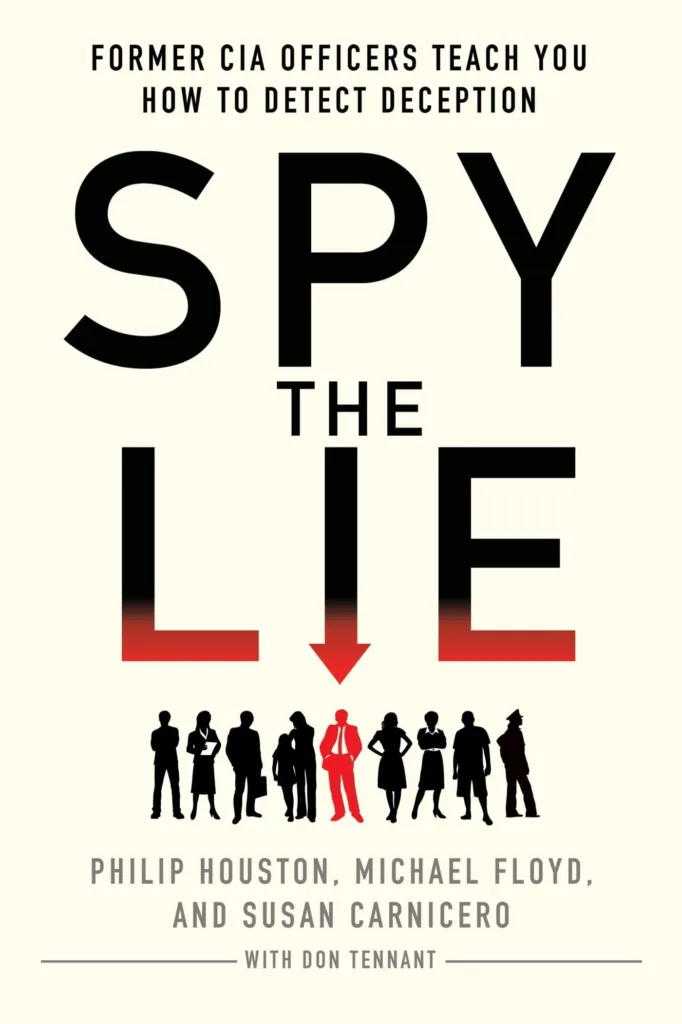
Spy the Lie proposes a way to decide which responses merit a follow-up question. The authors look for a group of behaviors whose first sign begins within five seconds of a specific question, without relying on a person’s general demeanor.
The authors are three former CIA officers — Philip Houston, Michael Floyd and Susan Carnicero — writing with Don Tennant. Houston developed the interviewing method at the Agency and later carried it into the private sector; the book, published by St. Martin's Press in 2012, is that method written down for a general reader.
Most behavior during an interview can have other explanations, including nerves, temperament or discomfort with the question. The authors link a cluster of indicators to a specific question by requiring its first sign to begin within five seconds; the response can continue beyond that interval.
The book describes a structured interview technique and gives less attention to research on how accurately people detect deception. The responses it singles out can suggest a follow-up question, and any conclusion about what happened needs corroboration.
Summary
Spy the Lie, by Philip Houston, Michael Floyd and Susan Carnicero with Don Tennant, sets out a deception-detection method drawn from the authors’ CIA careers. The procedure is to ask a clear, short question and look for a cluster whose first indicator begins within five seconds. That response is classified against a defined list of deceptive indicators. No single indicator counts, and the unit of analysis is a cluster of two or more. The chapters on question construction carry much of the practical value, because an ambiguous question cannot produce a readable answer. Since the book says little about false positives, the method is better suited to choosing a follow-up question than to drawing conclusions about a person.
What the book covers
The method is procedural rather than intuitive. Ask a clear, short question. Start a mental clock. Look for the first indicator within five seconds, then consider the response that follows. Classify what you see against a defined list of deceptive indicators — among them failure or reluctance to answer, repeating an earlier answer, inappropriate questions, aggressive replies, overly specific answers, excessive politeness and qualifiers.
Crucially, the authors insist that no single indicator means anything. A cluster of two or more in response to the same question is the unit of analysis. The cluster can include later behavior in the same uninterrupted response; general demeanor is not enough.
The chapters on question construction are particularly useful in practice. A badly built question produces an ambiguous response that no amount of observation can resolve, so most of the work is done before anyone answers anything.
The case studies show how the authors apply their method and give less attention to false positives. In a corporate interview, a truthful person may show several signs of stress simply because the interview is stressful. Those observations can guide follow-up questions, and any finding needs corroboration.
Implications for risk management
The interview offers something the documentary record cannot always supply. A person can explain where an account came from or point an investigator toward a record they had missed. The authors give question design some of the same attention investigators devote to evidence handling.
Focusing on the response to a specific question reduces the temptation to build an interview around an early impression, such as a change in posture or eye contact.
In an employment or misconduct investigation, observations can inform the next question or document request. Treating a deception assessment as a finding about a named person can create problems when the file is disclosed, particularly given the debate over the method’s accuracy.
In a corporate investigation, interviews come after documents have been reviewed and evidence preserved. That order lets each question be short and built around what the record already shows. We also consider whether a truthful interviewee may show signs of stress. A cluster of indicators therefore leads to a further document request or a follow-up interview, and it is never written up as a conclusion about the person.
Key takeaways
- The first indicator must begin within five seconds of the question. Look for a cluster in the response that follows.
- The method uses clusters of responses. The authors look for two or more behaviors in response to a single question.
- Most of the work is in the question. Ambiguous questions cannot produce readable answers.
- A change in demeanor may have several explanations. The method focuses on the response to a specific question so an early impression carries less weight.
- The method can guide further inquiry. A finding about an interviewee needs evidence that corroborates it.
About the authors


Philip Houston spent twenty-five years at the CIA, where he developed the interviewing and detection method the book sets out, and later applied it in corporate investigations. Michael Floyd and Susan Carnicero are also former CIA officers with backgrounds in interrogation, screening and behavioral assessment; all three subsequently worked in the private sector applying the same approach.
The cover credits the three of them "with Don Tennant," the collaborating writer — a distinction worth preserving, since he is frequently listed as a fourth co-author and is not one.

Where the proceeds go
We donate 100% of what we earn to Children of Fallen Heroes
If you buy through the link above we may earn a small commission, at no extra cost to you. Every penny of it goes to Children of Fallen Heroes, a registered 501(c)(3). We keep none of it.
They are developing an 82-acre campus in Vass, North Carolina for the children of military families, first responders and foster youth — STEAM education in aviation, robotics and drones, alongside leadership and healing programs. Over eleven years their programs have reached more than 15,000 young people and families.
We participate in the Amazon Services LLC Associates Program and similar affiliate programs; these relationships do not influence our recommendations. Cookies and similar technologies record interactions with affiliate links — see our Privacy Policy to disable them, or reach us via Contact.