
In 1983, Ronald Reagan watched the film WarGames — in which a teenager accidentally accesses a military computer — and asked General John Vessey, the Chairman of the Joint Chiefs, whether such a thing could actually happen.
A week later the answer came back: yes, and the problem was much worse than anyone thought.
Fred Kaplan's history of cyber warfare begins there and runs forward three decades, and its central finding is not that the threat was unforeseen. It was foreseen almost immediately, described accurately, and repeatedly deprioritized. For anyone assessing organizational risk, that pattern is the more useful lesson.
What the book actually covers
Kaplan traces the institutional history: the early NSA work on information warfare, the 1997 Eligible Receiver exercise in which a small internal team demonstrated that critical American systems could be penetrated with commercially available tools, the Moonlight Maze intrusions, the establishment of Cyber Command, Stuxnet, and the progression from espionage to disruption to the contemplation of physical destruction.
The strategic material is what earns its place on a corporate shelf. Kaplan is clear-eyed about the structural problem at the heart of state cyber policy: the same agencies charged with defending national networks have an operational interest in the vulnerabilities remaining exploitable. A flaw disclosed and patched is a flaw no longer available for intelligence collection. That tension has never been resolved, and it explains a great deal about why defense has consistently lagged offense.
He is equally good on attribution, which is the practical difficulty that shapes everything else. Establishing who conducted an intrusion is slow, uncertain and frequently political, and a response cannot be proportionate to an actor you cannot confidently name.
The organizational pattern recurs throughout: capable people identify a vulnerability, write it up accurately, and are heard politely. Action follows an incident rather than a warning, and by then the cost has been paid.
Why it matters for your risk posture
Read it because your organization almost certainly has its own Eligible Receiver — an internal assessment that identified a genuine exposure and was noted rather than funded. Kaplan's history is the large-scale version of a pattern that recurs at every size, and reading it makes the pattern easier to recognize in your own reporting.
Read it for the offense-defense tension, which has a direct commercial analogue. Wherever an organization benefits from a gap remaining open — a control that would slow a revenue process, a disclosure that would embarrass a partner — the incentive to leave it open is real and rarely stated aloud. Naming that dynamic is the first step to overriding it.
And read it for the attribution problem. Boards routinely ask who was responsible after an incident, and the honest answer is usually slower and less certain than anyone wants. Understanding why is what allows a sensible conversation about response.
Key takeaways
- The warning is rarely the missing piece. Vulnerabilities are typically identified early, accurately, and by people who are then not resourced. Look at what your own assessments already say.
- Offense and defense compete for the same flaw. Wherever someone benefits from a gap staying open, it stays open. The same incentive exists inside companies as readily as inside governments.
- Attribution is slow, uncertain and political. Plan a response process that does not depend on knowing who did it.
- Incidents move budgets; reports do not. A structural fact worth knowing before you write the report.
About the author

Fred Kaplan is a national security journalist who, at the time of the book, wrote the “War Stories” column for Slate, and has spent a career covering national security, defense policy and the strategy community. He holds a doctorate in political science from MIT and previously reported for the Boston Globe, where he was part of a team awarded the Pulitzer Prize.
His books include The Wizards of Armageddon, on the civilian strategists who shaped American nuclear doctrine, The Insurgents, on David Petraeus and the counterinsurgency debate, and The Bomb, on presidential nuclear decision-making.
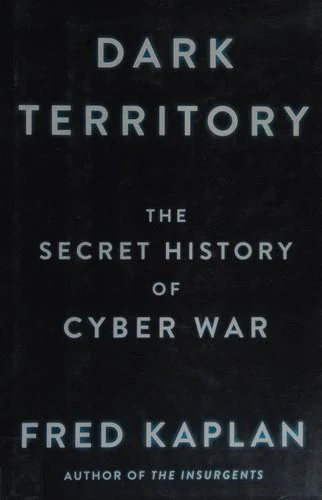
Dark Territory: The Secret History of Cyber War was published in 2016 and remains the standard narrative account of how state cyber capability developed.

Where the proceeds go
We donate 100% of what we earn to Children of Fallen Heroes
If you buy through the link above we may earn a small commission, at no extra cost to you. Every penny of it goes to Children of Fallen Heroes, a registered 501(c)(3). We keep none of it.
They run an 82-acre campus for the children of military families, first responders and foster youth — STEAM education in aviation, robotics and drones, alongside leadership and healing programs. More than 15,000 young people and families have been through it in eleven years.
We participate in the Amazon Services LLC Associates Program and similar affiliate programs; these relationships do not influence our recommendations. Cookies and similar technologies record interactions with affiliate links — see our Privacy Policy to disable them, or reach us via Contact.