
On October 16, 2017, a car bomb killed Daphne Caruana Galizia on a road near her home in Malta. She was the country's best-known investigative journalist. She was also, at the time of her death, the defendant in dozens of libel actions, several brought by serving politicians, with her bank accounts frozen by court order.
In July 2021 a public inquiry established by the Maltese state concluded that the state itself bore responsibility: it had failed to recognize the risk to her life, failed to act on it, and had allowed a culture of impunity to spread from the highest levels of government into the police and the regulators.
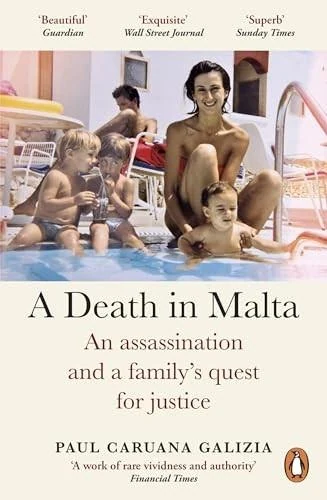
A Death in Malta is written by her youngest son. It is a memoir, and it is deliberately also a piece of reporting. For anyone assessing exposure in jurisdictions that look sound on paper, the second is the reason to read it.
What the book actually covers
The book runs three strands, and the first is family: a household organized around a mother whose work made it a target. One is national history — Malta from British colony to independence, to European Union membership in 2004, to a small state marketing itself hard on financial services, online gaming and residence-by-investment. The third strand is the investigation itself.
Her method is described without romance. She worked from documents — company filings, registries, correspondence — and from a long memory for who was connected to whom in a country small enough that everyone is connected to someone. Her blog, Running Commentary, became one of the most-read sites in Malta.
The substance of what she reported forms the book's spine: the sale of citizenship, banking supervision, the award of a major power-station concession, and, after the Panama Papers in 2016, offshore structures linked to a serving cabinet minister and to the prime minister's chief of staff. Her son sets out what she published, and what she had not yet published.
He is careful about sequence, and the bomb was the end of a process rather than a rupture in one. Before it came the libel suits, the freezing order, the surveillance, the organized abuse and the steady official framing of her as a partisan rather than a reporter. The later chapters cover the family's campaign, the Council of Europe's involvement, a pardoned middleman, the conviction of the men who planted and detonated the bomb, the charging of a businessman with complicity, the prime minister's resignation in early 2020, and the 2021 public inquiry.
The register is controlled throughout, and there is grief in the book, but it is not performed, and the author declines the thriller idiom the material would support.
Why it matters for your risk posture
Read it for the anatomy of institutional capture the public inquiry described, which is the book's real subject. Malta failed no formal test: an EU member state with a corporate registry, a financial regulator, a police force and rule-of-law language throughout its statute book. On the findings of the Maltese public inquiry of July 2021, the degradation was in enforcement and in willingness — who would investigate, who would prosecute, who would say anything on the record.
Read it because it shows what that degradation does to your own screening. Where journalists are being sued into silence and sources are frightened, adverse media checks come back clean because nothing gets published, not because nothing is happening. A quiet file in such a jurisdiction is a finding in itself, and should raise the standard of inquiry rather than close it.
Read it for the repricing that followed. Malta was placed on the Financial Action Task Force's list of jurisdictions under increased monitoring in June 2021 and removed a year later. Firms holding structures there found that correspondent banking friction and counterparty caution arrived well ahead of any legal consequence.
Key takeaways
- Capture looks lawful from outside. The institutions remain in place and the paperwork in order; what changes is who is willing to use them, and against whom.
- Silence is not clearance. An adverse media screen that returns nothing where reporting has been suppressed tells you about the press, not the counterparty.
- A state's own inquiry outranks any report you can buy. Where such findings exist, read them in full before commissioning anything else.
- Reputational repricing outruns the law. Banking access, insurance and counterparty appetite move on findings and listings long before any court concludes.
About the author

Paul Caruana Galizia is the youngest of Daphne Caruana Galizia's three sons. He trained as an economic historian and held academic research posts before his mother's murder, and afterwards moved into journalism.
He won the New Journalist of the Year award at the British Journalism Awards and an Orwell Prize special award; with his brothers he received a Magnitsky Human Rights Award for the family's campaign. A Death in Malta was named a book of the year by the Financial Times among others, and won the Overseas Press Club's Cornelius Ryan Award.
A Death in Malta: An Assassination and a Family's Quest for Justice by Paul Caruana Galizia, Cornerstone, 2023.

Where the proceeds go
We donate 100% of what we earn to Children of Fallen Heroes
If you buy through the link above we may earn a small commission, at no extra cost to you. Every penny of it goes to Children of Fallen Heroes, a registered 501(c)(3). We keep none of it.
They run an 82-acre campus for the children of military families, first responders and foster youth — STEAM education in aviation, robotics and drones, alongside leadership and healing programs. More than 15,000 young people and families have been through it in eleven years.
We participate in the Amazon Services LLC Associates Program and similar affiliate programs; these relationships do not influence our recommendations. Cookies and similar technologies record interactions with affiliate links — see our Privacy Policy to disable them, or reach us via Contact.