
In the early 1990s it was possible to believe the argument was settled. Communist regimes had fallen, elections were spreading, and the assumption in most Western capitals was that market economies and liberal politics were where every society would eventually arrive. Thirty years on, that assumption reads less like a forecast than a period costume.
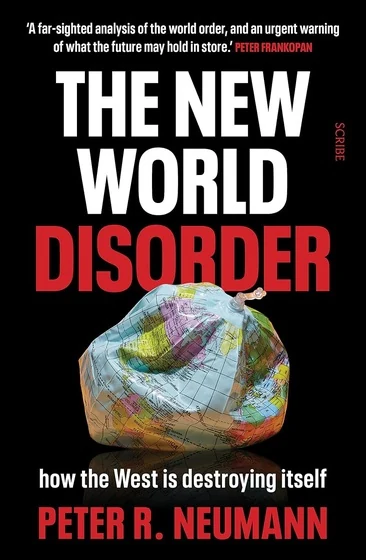
Peter R. Neumann's The New World Disorder: How the West Is Destroying Itself is an account of how the intervening decades were spent. His claim is not that the West was defeated by a rival, but that it squandered its advantage through a combination of naivete and arrogance — believing that others wanted what it had, and that its own preferences carried the force of history.
The subtitle is doing real work. This is a book about self-inflicted damage, which makes it more useful to anyone assessing cross-border exposure than another volume on Chinese or Russian intentions.
What the book actually covers
Neumann proceeds chronologically. He opens with the optimistic decade after 1989, when Western leaders embraced a vision of global democratization and set aside skeptics such as Samuel Huntington. He then works through 9/11 and the war on terror, the interventions in Afghanistan and Iraq, the doctrine of the Responsibility to Protect, the 2008 financial crisis, the Arab Spring, the annexation of Crimea, Brexit and Trump, and the war in Ukraine.
The through-line is a set of assumptions rather than a conspiracy: that history has a direction; that economic integration produces political convergence; that institutions can be exported. Each was defensible in 1995 and each was falsified. Neumann's interest is why the falsification took so long to register, and why the response was rhetorical rather than strategic.
His treatment of humanitarian intervention is the sharpest section. He argues that the Responsibility to Protect was applied selectively — according to media attention and geopolitical convenience rather than the severity of the crisis — and that the inconsistency was legible to everyone outside the Western bloc. The credibility cost, on his account, is now charged against every rules-based argument the West makes.
The domestic chapters treat internal fragility as part of the same story: the distributional effects of globalization, the financial crisis, the erosion of liberalism's appeal at home, polarization. His prescription is what he calls a sustainable modernity — hold to human rights and freedom, drop the assumption that every society wants the Western template, and accept that nationalism, religion and culture shape political preference. Reviewers have noted, fairly, that he is clearer on diagnosis than implementation.
Why it matters for your risk posture
Read it for the reframing of political risk from episodic to structural. Country models built in the convergence era treat instability as deviation from a trend toward openness. Neumann's argument is that no such trend exists, and that a model expecting reversion to liberal norms will understate how long adverse conditions persist.
Read it because it explains the credibility problem your counterparties may have with Western institutions. Where a supplier, partner or regulator in a third country treats sanctions regimes, ESG conditions and rules-based language with visible skepticism, the reasons are set out here. Understanding them is not endorsement; it is preparation.
Read it for the domestic chapters, the ones risk committees tend to skip. Neumann's case is that political volatility inside Western democracies is a risk variable in its own right, expressed as regulatory reversal, sanctions whiplash and abrupt changes to licensing and export control, on timescales shorter than most capital commitments.
Key takeaways
- Convergence was an assumption, not a law. Any exposure model that quietly expects a jurisdiction to drift back toward openness is carrying an unexamined 1990s premise.
- Inconsistency is remembered. Selective application of rules and interventions has a long tail, and it surfaces in how counterparties read your compliance obligations.
- Internal fragility is external risk. Instability in your home jurisdictions reaches operations as regulatory and sanctions volatility, not background noise.
- Take the diagnosis, not the remedy. The analysis is far stronger than the prescription; treat the closing chapters as a stance rather than a plan.
About the author
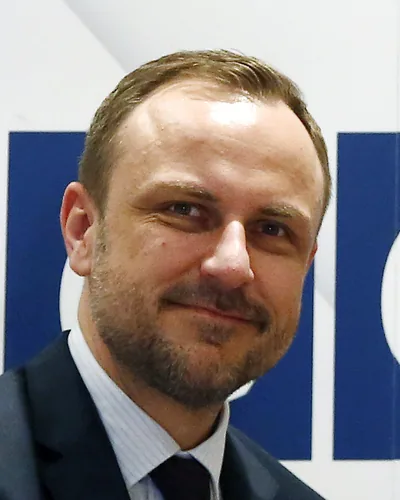
Peter R. Neumann was, as of the book's publication, Professor of Security Studies at King's College London, and was the founding director of the International Centre for the Study of Radicalisation there. German-born, he built his reputation on the study of terrorism and radicalization.
He has advised governments and international organizations, including a period as the OSCE's special representative on countering radicalization, and writes for English- and German-language press alike. The New World Disorder steps outside that specialism into general strategic argument, and reads as the work of someone who spent a career watching Western policy fail in a narrow field and concluded the problem was broader.
The New World Disorder: How the West Is Destroying Itself by Peter R. Neumann, translated by David Shaw, Scribe, 2023; first published in German as Die neue Weltunordnung (Rowohlt Berlin, 2022).

Where the proceeds go
We donate 100% of what we earn to Children of Fallen Heroes
If you buy through the link above we may earn a small commission, at no extra cost to you. Every penny of it goes to Children of Fallen Heroes, a registered 501(c)(3). We keep none of it.
They run an 82-acre campus for the children of military families, first responders and foster youth — STEAM education in aviation, robotics and drones, alongside leadership and healing programs. More than 15,000 young people and families have been through it in eleven years.
We participate in the Amazon Services LLC Associates Program and similar affiliate programs; these relationships do not influence our recommendations. Cookies and similar technologies record interactions with affiliate links — see our Privacy Policy to disable them, or reach us via Contact.