
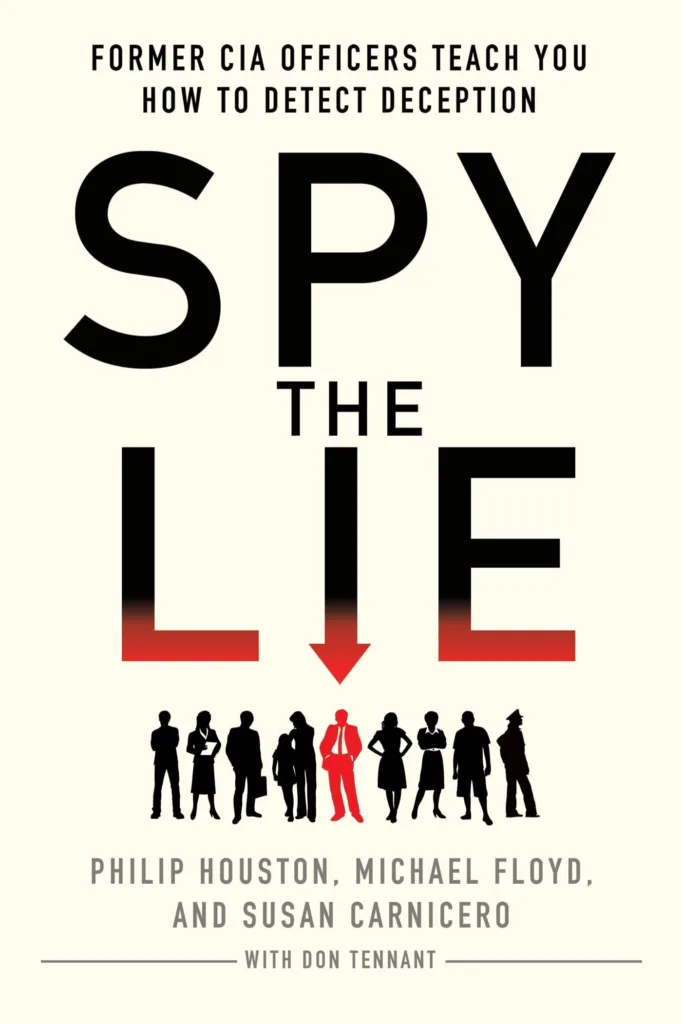
Most writing about deception detection is built on the premise that liars leak — that stress produces tells, and a trained observer can read them. Spy the Lie starts somewhere narrower and more defensible: ignore behavior in general, and attend only to what happens in the first five seconds after a question is asked.
The authors are three former CIA officers — Philip Houston, Michael Floyd and Susan Carnicero — writing with Don Tennant. Houston developed the interviewing method at the Agency and later carried it into the private sector; the book, published by St. Martin's Press in 2012, is that method written down for a general reader.
The core discipline is the discarding. Almost everything a person does in an interview is noise: nerves, temperament, dislike of being asked. The authors' claim is that only behavior occurring in direct response to a specific question, within a few seconds of it, carries any signal at all — and that most interviewers ruin themselves by reading the rest.
The claim to treat carefully is the accuracy one. Deception-detection research has been unkind to the field generally, and while this method is more disciplined than most, the book does not engage seriously with the literature on how poorly humans perform at this task. Use it to structure an interview, not to reach a verdict.
What the book actually covers
The method is procedural rather than intuitive. Ask a clear, short question. Start a mental clock. Attend only to the response in the first five seconds. Classify what you see against a defined list of deceptive indicators — failure to answer, non-answer statements, referral to a previous answer, inappropriate question, attack on the questioner, overly specific answer, inappropriate politeness or qualifiers.
Crucially, the authors insist that no single indicator means anything. A cluster of two or more in response to the same question is the unit of analysis. Everything else is discarded, including body language occurring outside the window, and including all the behavior people find most suggestive.
The chapters on question construction are the most practically useful and the least glamorous. A badly built question produces an ambiguous response that no amount of observation can resolve, so most of the work is done before anyone answers anything.
The weakest material is the case studies, which are chosen to demonstrate the method working and inevitably read that way. There is little on false positives — on the honest, frightened interviewee whose cluster of indicators means only that they are frightened — and that is the failure mode most likely to cause real damage in a corporate investigation.
Why it matters for your risk posture
Read it because the interview is usually the highest-value hour in an internal investigation and is almost never trained for. Investigators are trained on documents, on process, on evidence handling. The conversation is left to instinct, and instinct is where the errors are.
Read it for the discarding discipline specifically. The most common interviewing error is over-reading — building a theory from a shifting posture or a broken gaze, then interpreting everything afterward through it. A method whose first instruction is to ignore almost everything is a corrective to exactly that.
And read it against its own limits. In an employment or misconduct context, a deception assessment is not evidence and should never be recorded as though it were. Its legitimate use is to direct the next question and the next document request. Treated as a finding, it becomes a liability — a judgment about a named person, made on a contested method, in a file that may later be disclosed.
Key takeaways
- Only the first five seconds after a question count. Everything outside the window is noise.
- No single indicator means anything. Two or more in response to one question is the unit of analysis.
- Most of the work is in the question. Ambiguous questions cannot produce readable answers.
- Over-reading is the standard failure. A method that discards aggressively is a corrective to instinct.
- It directs inquiry; it does not establish fact. Never record a deception assessment as a finding about a person.
About the authors


Philip Houston spent twenty-five years at the CIA, where he developed the interviewing and detection method the book sets out, and later applied it in corporate investigations. Michael Floyd and Susan Carnicero are also former CIA officers with backgrounds in interrogation, screening and behavioral assessment; all three subsequently worked in the private sector applying the same approach.
The cover credits the three of them "with Don Tennant," the collaborating writer — a distinction worth preserving, since he is frequently listed as a fourth co-author and is not one.

Where the proceeds go
We donate 100% of what we earn to Children of Fallen Heroes
If you buy through the link above we may earn a small commission, at no extra cost to you. Every penny of it goes to Children of Fallen Heroes, a registered 501(c)(3). We keep none of it.
They run an 82-acre campus for the children of military families, first responders and foster youth — STEAM education in aviation, robotics and drones, alongside leadership and healing programs. More than 15,000 young people and families have been through it in eleven years.
We participate in the Amazon Services LLC Associates Program and similar affiliate programs; these relationships do not influence our recommendations. Cookies and similar technologies record interactions with affiliate links — see our Privacy Policy to disable them, or reach us via Contact.