
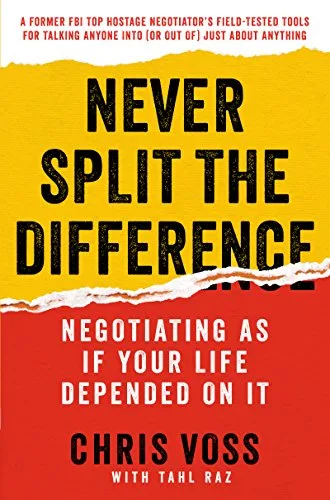
The title is an instruction, and it is aimed at a specific habit. Splitting the difference — meeting in the middle to end the discomfort — is what most people do when a negotiation stalls, and Chris Voss's argument is that it is usually the worst available outcome dressed up as fairness. Two parties who each wanted a whole thing walk away with half of one, and the deal that would have satisfied both goes unfound.
Never Split the Difference: Negotiating As If Your Life Depended On It was written by Voss with the journalist Tahl Raz and published by HarperBusiness in 2016. Voss was the FBI's lead international kidnapping negotiator, and the material comes from cases where a split difference was not on the table.
The underlying claim is that negotiation is not a rational exchange of positions but an exercise in making the other side feel understood accurately enough that they are willing to move. The techniques — mirroring, labeling, the deliberate use of "no," the calibrated question — all serve that end.
The book's weakness is the reverse of its strength. Because the source material is hostage negotiation, the stakes are always vivid, and vividness is persuasive in a way that evidence is not. Voss is describing what worked for him, not results from controlled study, and the reader should hold the confidence of the prose a little loosely.
What the book actually covers
The method is built from a small number of moves. Mirroring — repeating the last few words the other party said — to keep them talking. Labeling — naming the emotion you think you are hearing, prefaced with "it seems like" — to test whether you have read them correctly. The accusation audit, in which you state their likely objections before they do, defusing them in advance.
Two ideas run against common instruction. The first is that "no" is a beginning rather than an ending: people say no to retain control, and a negotiation that gets a comfortable no is often further along than one that has extracted an anxious yes. The second is that "that's right" — the moment the other party recognizes their own position in your restatement of it — is the real inflection point, and is quite different from "you're right," which usually means they want the conversation over.
The calibrated question is the practical core. Open questions beginning "how" or "what" that hand the other party the problem: how am I supposed to do that? They shift work without confrontation.
Where the book is thinnest is on the other side of the table. Every technique is presented from the position of someone applying it. There is little on how to recognize the same moves being run on you, which is what a reader in a commercial negotiation most needs.
Why it matters for your risk posture
Read it for the listening discipline, which is the transferable part. Labeling and mirroring are not rhetorical tricks; they are ways of testing whether your model of the other party is accurate before you commit to a position based on it. In diligence and negotiation alike, most errors are errors of assumed motive.
Read it for the deadline material. Voss is good on how artificial urgency degrades judgment, and on how often a deadline is one party's constraint presented as a shared fact. Recognizing whose clock is actually running is worth the price of the book.
And read it defensively. If these techniques work — and enough of them are now standard in commercial training that you will meet them — then the useful reading is inverted. When a counterparty labels your concerns back to you with unusual precision, or asks how you expect them to manage something, they may be doing this on purpose.
Key takeaways
- Splitting the difference is a way to end discomfort, not to find agreement. Both sides lose the deal that would have worked.
- "No" preserves the other party's control and often moves things forward; a fast "yes" frequently means nothing.
- "That's right" is the inflection point. "You're right" usually means they want you to stop talking.
- Calibrated questions transfer the problem without confrontation: how am I supposed to do that?
- Ask whose deadline it is. Urgency presented as shared is usually one party's constraint.
About the authors

Chris Voss is the book's lead author and a former FBI lead international kidnapping negotiator, with twenty-four years at the Bureau. He now runs a negotiation consultancy and teaches the method to business audiences.
Tahl Raz is a journalist and co-author who has collaborated on several business books; the cover and every publisher listing credit both names. The book is frequently attributed to Voss alone, which understates the collaboration that produced it.

Where the proceeds go
We donate 100% of what we earn to Children of Fallen Heroes
If you buy through the link above we may earn a small commission, at no extra cost to you. Every penny of it goes to Children of Fallen Heroes, a registered 501(c)(3). We keep none of it.
They run an 82-acre campus for the children of military families, first responders and foster youth — STEAM education in aviation, robotics and drones, alongside leadership and healing programs. More than 15,000 young people and families have been through it in eleven years.
We participate in the Amazon Services LLC Associates Program and similar affiliate programs; these relationships do not influence our recommendations. Cookies and similar technologies record interactions with affiliate links — see our Privacy Policy to disable them, or reach us via Contact.