
Most organizations meet white-collar law backward. The first real encounter is rarely a training module; it is a subpoena, a whistleblower letter, or a regulator's question about a transaction closed three years ago. By then the inquiry is narrow, the timeline fixed, and the answers whatever the files contain.
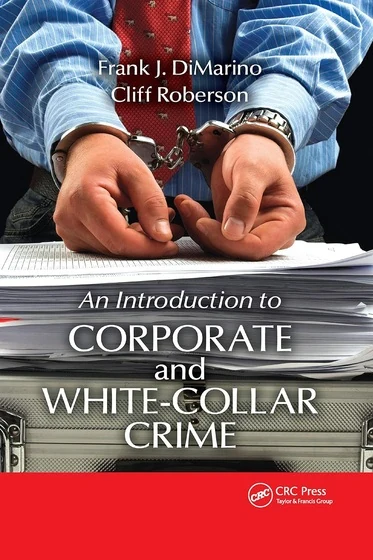
Introduction to Corporate and White-Collar Crime is a textbook and does not pretend otherwise. What earns it a place here is the arc. Frank J. DiMarino served as a federal prosecutor before moving into legal education; Cliff Roberson has spent a career writing criminal justice texts. It works outward from the conditions that produce these offenses to the statutes that reach them and the sanctions that follow.
For general counsel, CFOs, and risk leaders, that ordering is the value. Read as an operating document, it starts where a compliance program should — with the conditions that make the conduct possible — and ends where one is judged: with what the statutes reach, and what happens when they do.
What the book actually covers
The opening chapters are criminological rather than doctrinal: the study of white-collar crime and how it came to be defined (Ch. 1), the traditional explanations for it (Ch. 2), and the opportunity structures that make it possible (Ch. 3), with Sutherland's founding article on white-collar crime reprinted as an appendix. That is the front third of the book, and it colors what follows.
The middle chapters work through the offense areas: the securities laws (Ch. 4), banking and currency-related crimes including money laundering (Ch. 5), racketeering and organized crime (Ch. 6), crimes involving public officials (Ch. 7), and obstruction of justice (Ch. 8) — the charge that so often attaches to the response rather than the underlying act.
The closing chapters turn to consequences: the sanctions available against white-collar offenders (Ch. 9), and the control and prevention strategies aimed at the conditions that produce the conduct in the first place (Ch. 10).
Worth a board's attention is the liability rule sitting underneath all of this. Under US law an organization can be held answerable for offenses its employees commit within the scope of their employment and for the company's benefit. It is a wide net, which is why a compliance program's credibility matters more than its existence on paper.
It is worth being clear about the register. This is an introductory survey written for students, not a practitioner's manual or a collection of war stories. It moves in outline and declines to digress. Published in 2013, it also predates more than a decade of revision in Department of Justice policy on corporate enforcement and individual accountability. The underlying doctrine has aged better than any snapshot of enforcement policy from that year.
Why it matters for your risk posture
Read it for the elements above all. A prosecution is not a narrative; it is a list of things that must each be proven to a standard. The contested element is usually what a person knew, and when. Knowledge is proved with documents written long before anyone was under suspicion — an argument for recording decisions as they are made, with the reasoning intact.
Read it because the investigation is the event. Long before any charging decision, an inquiry consumes executive attention, freezes document disposal, separates the company's interests from those of its employees, and runs alongside regulators, auditors, and civil claimants. The book does not walk through that sequence, but its map of the offense categories is the first step toward planning around it.
Read it with the distinction between the entity and the individual in mind. The two are not charged on the same theory, carry different exposure, and rarely keep identical interests once an inquiry begins. Knowing how the tracks separate is what lets counsel set the terms of an internal investigation — representation, privilege, disclosure — before the pressure arrives.
Key takeaways
- The proof problem is usually intent, not conduct. The acts tend to be visible in the record; what gets litigated is what the actors knew. Contemporaneous reasoning remains the cheapest defense available to anyone.
- Corporate liability is broad by design. An organization answers for employees acting within their roles, making the program, the escalation path, and the response the variables you control.
- The response is frequently the exposure. Obstruction and false-statement charges attach to conduct after the fact and reach people with no part in the original problem.
- It is a primer and should be used as one. Best for giving non-lawyers a working map of the field, not for resolving a live question.
About the authors

Frank J. DiMarino is a former United States federal prosecutor who moved into legal education. That background informs the offense chapters, which stay close to what the statutes actually require.
Cliff Roberson is a legal scholar and the author of a long list of criminal justice texts. The instructional discipline here — the definitions, the ordering, the refusal to wander — reflects that experience.
Introduction to Corporate and White-Collar Crime, by Frank J. DiMarino and Cliff Roberson, was published by CRC Press (Taylor & Francis) in 2013.

Where the proceeds go
We donate 100% of what we earn to Children of Fallen Heroes
If you buy through the link above we may earn a small commission, at no extra cost to you. Every penny of it goes to Children of Fallen Heroes, a registered 501(c)(3). We keep none of it.
They run an 82-acre campus for the children of military families, first responders and foster youth — STEAM education in aviation, robotics and drones, alongside leadership and healing programs. More than 15,000 young people and families have been through it in eleven years.
We participate in the Amazon Services LLC Associates Program and similar affiliate programs; these relationships do not influence our recommendations. Cookies and similar technologies record interactions with affiliate links — see our Privacy Policy to disable them, or reach us via Contact.