
Every compliance function eventually runs into the same conversation. Something has been done that everyone in the room finds distasteful, nobody can quite name the offense, and the argument settles into whether it was wrong or merely aggressive. Stuart Green's book is the most rigorous attempt we know of to answer that question properly, and it is uncomfortable reading in both directions.
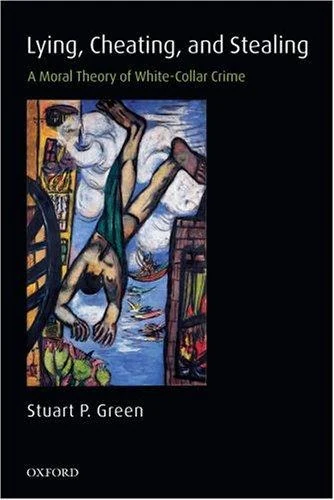
Lying, Cheating, and Stealing is a work of legal philosophy rather than a practitioner's manual, and it is worth the adjustment. Green's project is to identify what, morally, white-collar offenses actually consist of — and to show that the intuition that they are somehow lesser crimes survives contact with the analysis far less well than most people assume.
What the book actually covers
Green's method is to decompose white-collar crime into its moral components rather than treat it as a single category. The recurring elements are deception, cheating, disloyalty, promise-breaking and exploitation — and his argument is that these are genuinely distinct wrongs that happen to travel together, not synonyms.
The treatment of cheating is the most useful part for a risk audience. Green separates it from ordinary deception: cheating involves violating a rule of a cooperative activity in order to take an unfair advantage, while others continue to observe it. That definition does a good deal of real work. It explains why conduct which harms no identifiable individual can still be seriously wrong, and why “no one lost money” is not the exculpation people reach for it to be.
He then works through the offense categories — among them perjury, obstruction, bribery, extortion, fraud, insider trading and tax evasion — asking in each case what the underlying moral wrong is and whether the criminal law has drawn its line in the right place. He is willing to conclude in both directions: some conduct is criminalized on thin moral foundations, and some genuinely serious wrongdoing sits outside the criminal law entirely.
Why it matters for your risk posture
Read it because “legal” is a floor, not a finding. The most consequential exposures we see are rarely clean statutory breaches; they are arrangements that are technically defensible and morally obvious to anyone outside the organization. Green gives you the vocabulary to articulate why something is wrong when the compliance answer is that it is permitted.
Read it for the cheating framework specifically. Applied to a counterparty, the question “which rule of the cooperative activity is this party quietly not observing, while relying on everyone else to observe it?” is a surprisingly efficient screen — for market conduct, for procurement, for the structuring of related-party arrangements.
And read it as a corrective to the moral discount applied to financial wrongdoing. Green's analysis undermines the intuition that offenses without a visible victim are lesser offenses. That intuition is precisely what lets serious conduct persist inside organizations that consider themselves ethical.
Key takeaways
- Deception, cheating and disloyalty are different wrongs. Naming which one is in play sharpens both the assessment and the conversation with the board.
- Cheating is rule-violation for unfair advantage while others comply. It explains harm without an identifiable victim — and it is the shape most market misconduct takes.
- “Nobody lost money” is not a defense. The absence of a traceable loss says nothing about whether a wrong occurred.
- The criminal line and the moral line are not the same line. Some permitted conduct is seriously wrong; assessing only legality will miss it.
About the author

Stuart P. Green's scholarship centers on criminal law theory and the moral foundations of white-collar and property offenses. He has taught criminal law in the United States and has written extensively on how criminal prohibitions map — or fail to map — onto underlying moral wrongs.
Lying, Cheating, and Stealing: A Moral Theory of White-Collar Crime was published by Oxford University Press in 2006, in its Oxford Monographs on Criminal Law and Justice series. Green has since written further book-length treatments of theft and of the boundaries of property crime.
Where the proceeds go
We donate 100% of what we earn to Children of Fallen Heroes
If you buy through the link above we may earn a small commission, at no extra cost to you. Every penny of it goes to Children of Fallen Heroes, a registered 501(c)(3). We keep none of it.
They run an 82-acre campus for the children of military families, first responders and foster youth — STEAM education in aviation, robotics and drones, alongside leadership and healing programs. More than 15,000 young people and families have been through it in eleven years.
We participate in the Amazon Services LLC Associates Program and similar affiliate programs; these relationships do not influence our recommendations. Cookies and similar technologies record interactions with affiliate links — see our Privacy Policy to disable them, or reach us via Contact.