
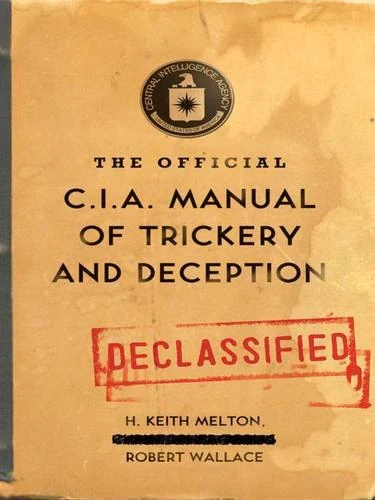
In the 1950s the CIA hired John Mulholland, one of the most accomplished stage magicians in America, to write a manual.
Not about entertainment. About operational technique — how to perform an action while an observer is watching and does not see it, how to direct attention away from what matters, how to make a deliberate act appear accidental. The manuals were believed destroyed. Copies surfaced decades later, and this book reproduces them with historical context.
It is a genuinely strange document, and it is more useful to a security professional than that description suggests.
What the book actually covers
Melton and Wallace — an intelligence historian and a former director of the CIA's Office of Technical Service — supply the context, and the Mulholland material itself forms the core.
Mulholland's insight, which he had spent a career proving on stage, was that deception is fundamentally about managing attention rather than concealing objects. An observer sees what they are directed to see and reconstructs the rest from expectation. The manual works through the practical consequences: how to perform an action in plain sight, how to use natural gesture to cover an intentional one, how the observer's own assumptions do most of the work.
There is material on how to behave inconspicuously, on the tradecraft of appearing to be an ordinary person doing an ordinary thing, and on the psychology of what people actually notice and retain — which is considerably less than they believe.
The historical framing is substantial and is what makes the book publishable rather than merely curious. Melton and Wallace situate the manuals in the Cold War technical-operations context, explain what they were commissioned for, and are appropriately careful about MKUltra, the CIA behavioral-research program the manuals were commissioned under.
Why it matters for your risk posture
Read it for the attention principle, which is the transferable core. Social engineering works the same way stage magic does: the target is not deceived about a fact so much as directed away from the place where the fact would have been visible. Understanding attention as the medium of deception is what makes pretexting recognizable in progress rather than in hindsight.
Read it for the inconspicuousness material, which is directly relevant to physical security. Mulholland's account of what makes a person unremarkable in a space — and therefore unchallenged — is the same analysis that explains why tailgating and unescorted access work so reliably in corporate environments.
And read it for the reliability lesson about observation. The manual is, incidentally, a sustained demonstration of how poor human observation and recall actually are. For anyone weighting witness accounts in an investigation, that is a useful and slightly uncomfortable calibration.
Key takeaways
- Deception manages attention, it does not conceal objects. The observer sees what they are directed to see and fills in the rest from expectation.
- The target's own assumptions do the work. The most effective deceptions supply a plausible frame and let the subject complete it themselves.
- Inconspicuousness is a technique. Appearing to belong is a set of learnable behaviors, which is why physical access controls fail against confident people.
- Human observation is unreliable in specific, predictable ways. Weight witness accounts accordingly.
About the authors

H. Keith Melton is an intelligence historian, a founding board member of the International Spy Museum, and a long-standing writer on espionage technology and tradecraft, with a substantial list of publications on the technical side of intelligence work.
Robert Wallace directed the CIA's Office of Technical Service — the division responsible for the technical support of clandestine operations — from 1998 to 2002, and retired from the Agency in 2003 after a 32-year intelligence career. Together they have written several books on intelligence tradecraft, including Spycraft, which is the fuller treatment of the technical history.
The book reproduces John Mulholland's manuals, written in the 1950s under CIA commission. Mulholland was among the most respected stage magicians of his era and a serious writer on the theory of magic before the intelligence work.
Where the proceeds go
We donate 100% of what we earn to Children of Fallen Heroes
If you buy through the link above we may earn a small commission, at no extra cost to you. Every penny of it goes to Children of Fallen Heroes, a registered 501(c)(3). We keep none of it.
They run an 82-acre campus for the children of military families, first responders and foster youth — STEAM education in aviation, robotics and drones, alongside leadership and healing programs. More than 15,000 young people and families have been through it in eleven years.
We participate in the Amazon Services LLC Associates Program and similar affiliate programs; these relationships do not influence our recommendations. Cookies and similar technologies record interactions with affiliate links — see our Privacy Policy to disable them, or reach us via Contact.